
Understanding Geothermal Energy: Heat from the Earth
Geothermal energy, is the energy derived from the earth’s natural heat, it combines the terms “geo” (earth) and “thermal” (heat).
This energy originates from geothermal resources, which are reservoirs of hot water found naturally or created artificially beneath the earth's surface at varying depths and temperatures. By drilling wells that range from a few feet to several kilometers deep, steam and hot water can be extracted and brought to the surface for a wide range of applications.
Applications of Geothermal Energy
Electricity Generation
Deep underground, conditions involving hot rocks, fluid, and permeability—the ability for fluid to move through rock formations—enable the production of electricity. In geothermal systems, fluid moves through hot rocks, absorbing their heat. This heated fluid is then pumped to the surface, where it is converted into steam to drive turbines and generate electricity.
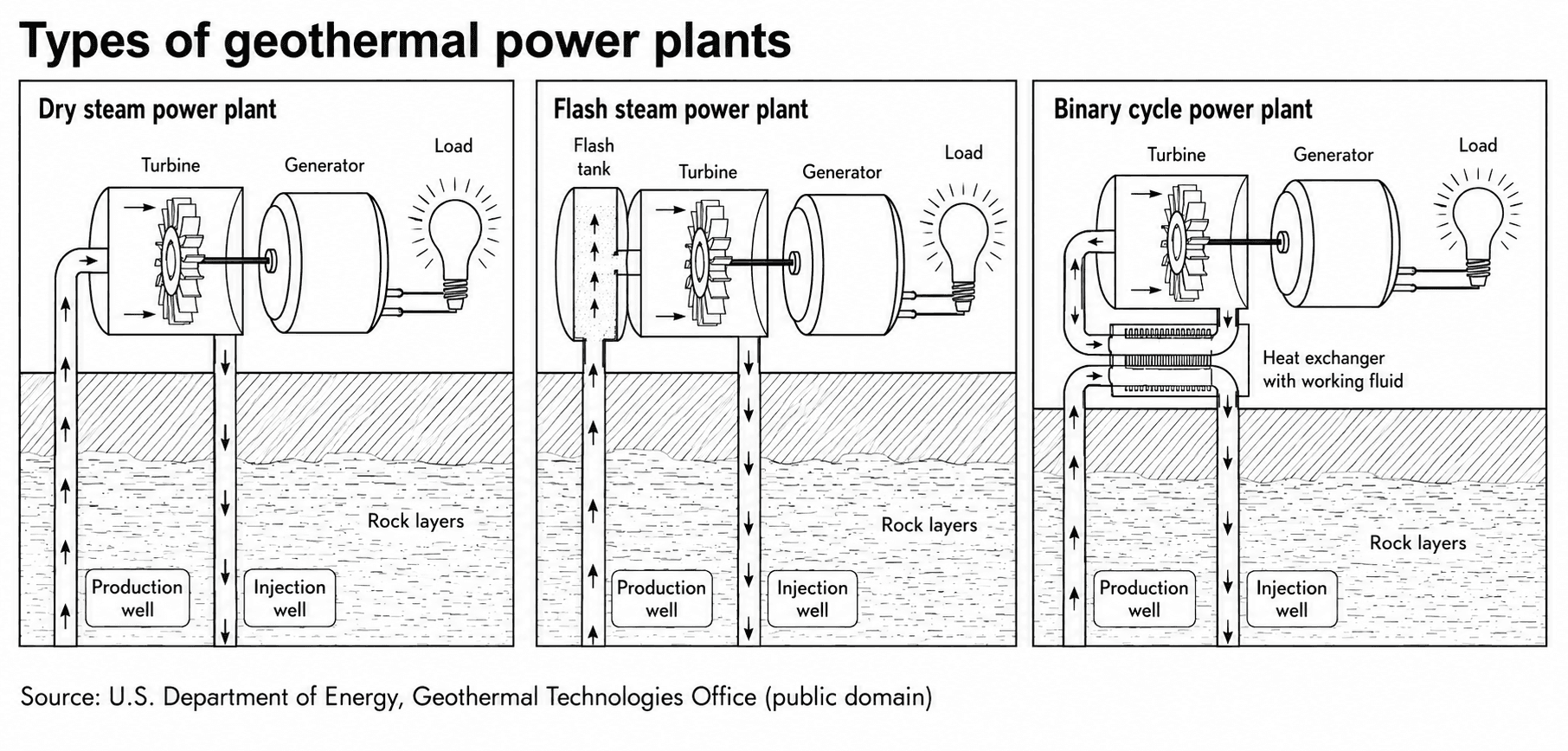
There are three types of geothermal power plants: dry steam, flash steam, and binary cycle.
Source: U.S Department of Energy
Dry Steam
The most common technology, this involves the use of steam at high temperatures (over 235°C) and pressure to move a turbine paired with an electrical energy generator.
Flash Steam
Flash steam power plants use geothermal reservoirs of water with temperatures greater than 182°C. This very hot water flows up through wells in the ground under its own pressure. As it flows upward, the pressure decreases and some of the hot water boils into steam. The steam is then separated from the water and used to power a turbine/generator. Any leftover water and condensed steam are injected back into the reservoir, making this a sustainable resource.
Binary Steam
Binary cycle power plants operate on water at lower temperatures of about 107-182°C. Binary cycle plants use the heat from the hot water to boil a working fluid, usually an organic compound with a low boiling point. The working fluid is vaporized in a heat exchanger and used to turn a turbine. The water is then injected back into the ground to be reheated. The water and the working fluid are kept separated during the whole process, so there are little or no air emissions.
Heating and Cooling
Geothermal energy is not just for electricity; it is also widely used to heat and cool buildings. Technologies like geothermal heat pumps utilize the stable temperatures found beneath the earth’s surface.
These systems act as a heat sink during warm weather, absorbing excess heat from aboveground, and as a heat source during colder periods, transferring heat upward. District heating and cooling systems take this concept further by using networks of geothermal heat pumps to regulate the temperature of entire communities, campuses, or clusters of buildings.
Advantages of Geothermal Energy
1. Low Cost: Geothermal systems are highly cost-effective, with competitive electricity generation costs.
2. Year-Round Operation: Geothermal plants operate at high-capacity factors and can provide steady, reliable electricity throughout the year.
3. Dispatchable Power: Unlike solar and wind, geothermal energy can deliver firm, on-demand electricity. It can also provide ancillary services to the grid when incentivized, making it increasingly valuable as renewable energy sources like wind and solar grow.
According to the International Energy Agency (IEA), the levelized cost of electricity (LCOE) from geothermal power projects ranged between USD 0.049 and USD 0.085 per kWh between 2010 and 2020. This renewable energy source meets a significant share of electricity demand in countries like Iceland, El Salvador, New Zealand, Kenya, and the Philippines. In Iceland, geothermal energy provides more than 90% of the country’s heating needs.
Emerging Technologies
In recent years, advancements in geothermal energy have expanded its potential:
1. Binary Cycle Technology: Medium-temperature geothermal fields are increasingly being used for electricity generation or combined heat and power. In this system, geothermal fluid heats a secondary process fluid in a closed loop through heat exchangers, enabling energy extraction from lower temperatures.
2. Enhanced Geothermal Systems (EGS): This innovative approach involves artificially enhancing underground permeability to tap geothermal resources in areas without natural reservoirs. Although still in the demonstration phase, EGS holds significant promise for expanding geothermal energy use.
Frequently Asked Questions:
1. How is geothermal electricity generated?
Heated fluids from underground reservoirs are used to produce steam that drives turbines in dry steam, flash steam, or binary cycle plants.
2. What are the types of geothermal power plants?
Dry steam, flash steam, and binary cycle plants.
3. How is geothermal energy used for heating and cooling?
Geothermal heat pumps transfer heat to or from the ground to regulate building temperatures year-round.
4. What are the advantages of geothermal energy?
Low cost, year-round operation, reliable and dispatchable electricity, and minimal emissions.
5. What are some emerging geothermal technologies?
Binary cycle technology for medium-temperature fields and Enhanced Geothermal Systems (EGS) to tap resources in areas without natural reservoirs.