Introduction
Lithium-ion (Li-ion) batteries have become a cornerstone for modern energy storage, powering everything from smartphones and laptops to electric vehicles and grid storage systems. However, ensuring the health and long-term performance of Li-ion battery packs demands a smart and efficient battery management system (BMS). Environmental and operational variations often lead to charge imbalances among individual cells or modules in Li-ion battery packs. Therefore, charge balancing is one of the most essential functions that every BMS must include.
Why Charge Balancing Is Necessary
A Li-ion battery pack consists of multiple cells connected in series (to increase voltage) and parallel (to increase capacity) configuration. However, factors such as manufacturing inconsistencies, aging, temperature variations, and non-ideal cell characteristics lead to an imbalanced battery pack. A common observation is that a battery pack reaches its fully charged or discharged state faster than expected, reducing its maximum capacity utilization. The dominance of imbalanced cells or modules within the battery pack primarily causes such behavior, as shown in Figure 1.
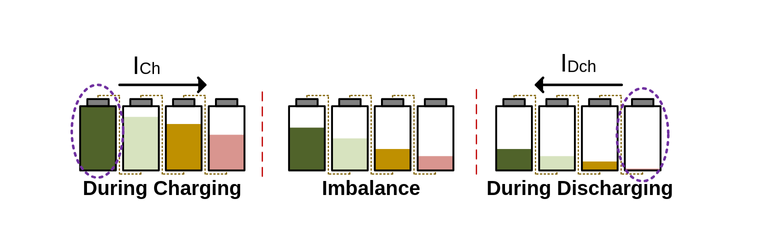
Figure 1. Charge-Discharge operation of an imbalanced battery pack
Imbalanced cells cause:
1. Reduced usable capacity (limited by the weakest cell)
2. Risk of overcharging or over-discharging certain cells
3. Thermal instability and safety hazards
4. Accelerated degradation
Therefore, maintaining equal State of Charge (SoC) or voltage across all cells is essential for optimizing the performance, safety, and health of the battery pack.
Charge Balancing Operation
Charge balancing techniques are generally classified into three categories: passive balancing, active balancing, and reconfiguration methods, as illustrated in Figure 2. Among these, passive balancing is a common feature in commercial BMS, using switched resistors to dissipate excess charge as heat, shown in Figure 3. On the other hand, reconfiguration methods, shown in Figure 4—based on cell bypassing—can introduce surge currents during switching transitions, potentially degrading cell health over time. Active charge balancing provides a more advanced and energy-efficient solution compared to other methods. In this blog, we explore the principles of active balancing, how it operates, and why it is crucial for maintaining high-performance Li-ion battery packs.
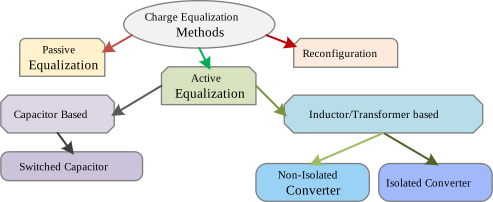
Figure 2. Classification of Charge Balancing Methods
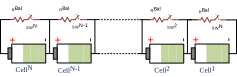
Figure 3. Passive Charge Balancing
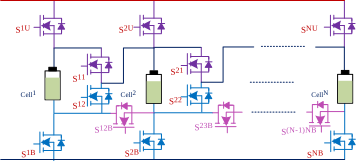
Figure 4. Reconfiguration Charge Balancing
Active Charge Balancing
Active charge balancing works by redistributing energy from higher-charged cells to lower-charged ones through various techniques. This approach maximizes the usable energy of the battery pack without dissipating excess charge as heat. Figure 5 presents an overview of different active balancing topologies and architectures.
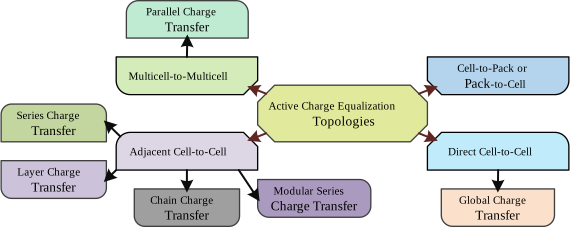
Figure 5. Active charge balancing topologies
Active vs. Passive Balancing
Feature | Passive Balancing | Active Balancing |
Energy Efficiency | Low (dissipates excess energy as heat) | High (transfers charge between cells) |
Thermal Management | Needs better cooling | Less heat generation |
Complexity | Simple circuits | More complex (requires control logic) |
Cost | Low | Higher initial cost |
Battery Life Impact | Moderate | Better long-term performance |
Active balancing topology is divided into four types based on how the charge is redistributed: direct cell-to-cell, adjacent cell-to-cell, multicell-to-multicell, and hybrid cell-to-pack-to-cell architectures, as shown in the below figures. Charge redistribution is managed by equalizers (Eqz), which are typically DC-DC converters built using components such as capacitors, inductors, or transformers. Based on the balancing architecture, the design and selection of equalizers and their components are determined.
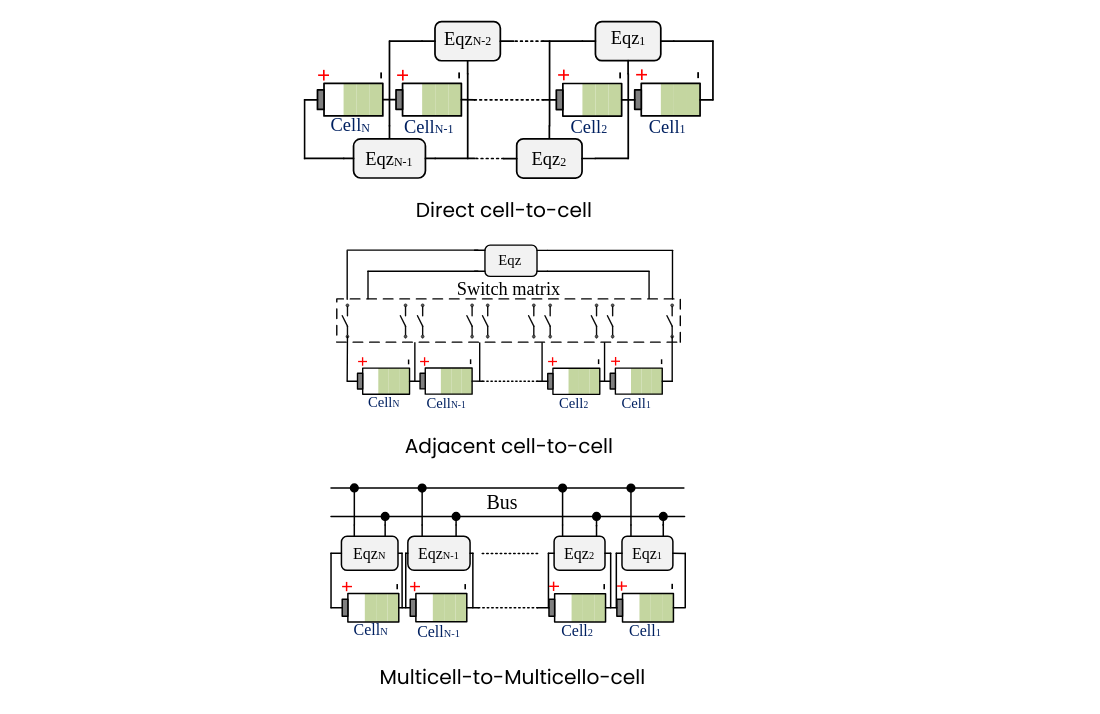
Common Equalizer Circuits
Capacitor-Based Balancing
1. A capacitor alternately connects to cells and transfers charge.
2. Chains of capacitors (Switched Capacitor) move energy across cells gradually.
3. Suitable for low to moderate balancing operation.
4. Compact and easier to implement but slower.
Inductor/Transformer-Based Balancing
1. Uses inductors (Buck-Boost, Cuk) or flyback converters to move charge between cells.
2. Offers high efficiency and better scalability.
3. Ideal for large battery systems (e.g., EVs, grid storage).
Advantages of Active Balancing
1. Higher energy efficiency: Conserves energy by redistribution, not dissipation.
2. Improved lifespan: Reduces stress on individual cells.
3. Scalability: Better suited for large battery packs.
4. Faster balanced battery pack
5. Enhanced safety
Challenges and Design Considerations
Although active balancing offers significant advantages, it also presents several challenges:
1. Circuit complexity: More components are required, necessitating sophisticated control algorithms.
2. Cost: Higher development cost, though it may pay off over time.
3. Balancing speed: Depends on the topology and equalizer power ratings.
4. Firmware/Algorithm design: Requires precise SoC estimation and real-time control.
Real-World Applications
1. Electric Vehicles (EVs): Ensure maximum driving range and battery longevity.
2. Renewable Energy Systems: Balance large storage banks in solar/wind systems.
3. Uninterruptible Li-ion-based Power Supplies (UPS)
Conclusion
Active charge balancing is a powerful tool for managing Li-ion battery packs, especially in applications where efficiency, lifespan, and safety are important. While it introduces added complexity and cost, the long-term gains make it an increasingly attractive solution as energy storage becomes more vital across industries.
Understanding the principles of active balancing can help engineers and system designers create more robust, efficient, and future-ready energy solutions.
Do you want to implement an active balancing system? Stay tuned for our upcoming posts on circuit design, simulation, and embedded implementation!
Frequently Asked Questions:
1. Why do Li-ion battery packs need charge balancing?
Li-ion packs have many cells. Some cells charge or discharge faster than others, which makes the pack unbalanced. Balancing keeps all cells equal so the battery is safer, lasts longer, and gives more usable energy.
2. What happens if cells are not balanced?
Unbalanced cells reduce the usable battery capacity, increase the risk of overheating, and cause faster aging. They can also make the whole battery unsafe.
3. What is passive charge balancing?
Passive balancing burns off extra energy from stronger cells as heat using resistors. It is simple and cheap but wastes energy and produces heat.
4. What is active charge balancing?
Active balancing moves extra energy from stronger cells to weaker ones instead of wasting it as heat. This makes the battery more efficient and helps it last longer.
5. How is active balancing better than passive balancing?
Active balancing saves energy, produces less heat, and improves battery life. Passive balancing is cheaper and simpler but less efficient.


