Why Our Power Goes Out - Understanding Peak Demand and Load Shedding
Imagine it’s a hot summer evening, with your phone charging in the corner and a fan running at full speed. All of a sudden, everything stops working. The room falls silent, the fan stops, and the lights go out. A loss of power. It's annoying, but have you ever pondered why it truly occurs? Peak demand and load shedding are frequently the two key terms that hold the answer.
Before we get into why power goes out, it's useful to understand how electricity reaches your home. Power plants use coal, hydro, nuclear, solar, or wind energy to generate electricity. After that, it travels large distances on high-voltage lines before being delivered to residences and commercial buildings via nearby substations.
Supply and demand must be balanced in real time in this delicate and ongoing process. Since electricity is more difficult to store than water (apart from in pumped storage systems or specialized batteries), any mismatch between supply and demand could result in significant disruptions.
Peak Demand
The term "peak demand" describes the period of time when electricity consumption is at its highest. This typically occurs during certain times of the day.
According to the Institute of Energy Economics and Financial Analysis, India’s peak electricity demand typically occurs around 3 PM during solar hours and again between 9 PM and 11 PM during non-solar hours, driven by rising air conditioning loads, intensifying heatwaves, and growing industrial and commercial demand.
India's Peak Electricity Demand Trends
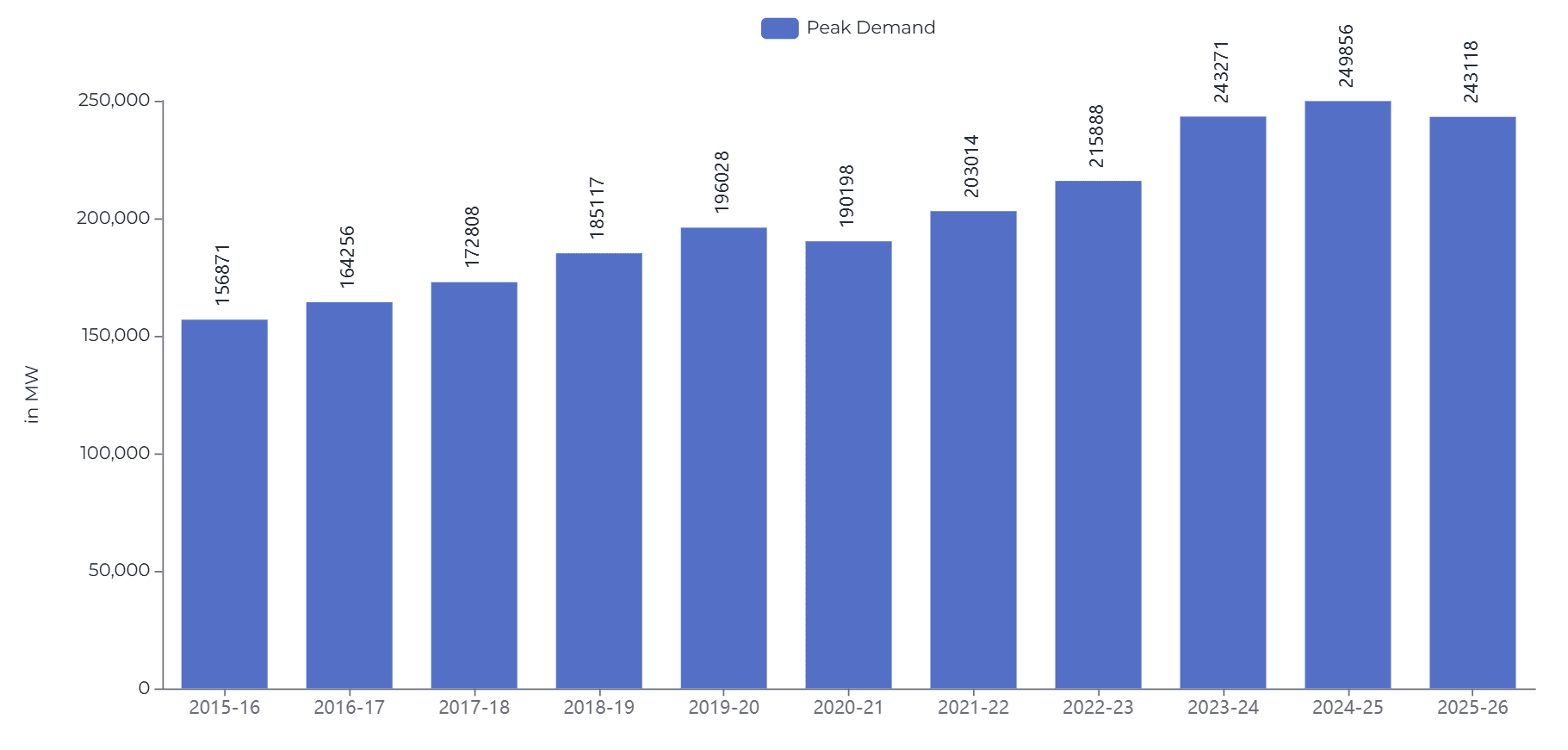
Source: NITI Aayog, Grid-India, and CEA
Electricity providers design their systems to handle average or moderately high demand, but not always the absolute peak. Why? Because it is very costly and frequently inefficient to build infrastructure to supply that infrequent peak load. For example, just because there is traffic on one festival weekend each year doesn't mean you should build a 20-lane highway.
But when demand outpaces supply, something must give. This is where load shedding is useful.
Load Shedding
Load Shedding is a planned and controlled method of turning off electricity in specific locations to keep the entire grid from being overloaded.
DISCOMs (Distribution Companies) will plan short-term power outages in designated areas rather than allowing the grid to become unstable and run the risk of a large, unforeseen blackout that impacts everyone. It’s like diverting a few cars off the road during a traffic jam to prevent a complete block across the entire city.
Usually, load shedding is applied in zones or blocks, with outages occurring at various times in each area. This makes it possible for electricity providers to allocate the scarce power in a more equitable and controllable manner.
Causes of Load Shedding and Power Cuts
Storms, floods, cold snaps, and heat waves can all put stress on the electrical grid. Demand increases during hot weather because more people use air conditioners. They can also make transmission lines and power plants less efficient, which lowers supply.
Many power plants run on coal, natural gas, or oil. If there's a disruption in the supply chain due to strikes, import delays, or geopolitical tensions, power generation drops, leading to load shedding.
Transmission systems and older power plants are prone to failure, particularly under stress. Equipment becomes less dependable without routine maintenance and upgrades, which raises the likelihood of outages.
Electricity availability may be impacted by planned maintenance, unforeseen malfunctions, or grid issues. Load shedding may occur if sufficient capacity is unavailable, even for a brief period of time.
Avoiding Load Shedding
In order to control peak demand, consumers are crucial. The grid can be less stressed by taking small steps, such as using energy-efficient appliances, turning off lights when not in use, and relocating appliances with high electricity usage to off-peak hours.
Smart meters and smart grids are examples of advanced technologies that help utilities better monitor and control power flow. They reduce the need for load shedding by automatically adjusting supply and demand in real-time.
Energy Storage is also a very important technology that can store excess electricity produced during off-peak hours (or from intermittent sources like solar) and can be released when demand increases.
Although power outages may appear to be a minor annoyance, they are frequently the outward sign of a much more serious and intricate issue. Our energy systems are under more strain than ever as a result of the growing demand for electricity brought on by urbanization, population growth, and the growing digitization of daily life.
We can see that outages aren't always the result of incapacity or poor management when we comprehend ideas like load shedding and peak demand. They are occasionally required trade-offs to safeguard the larger electrical grid.
Frequently Asked Questions:
1. Why does electricity demand spike at certain times?
Demand rises during the hottest parts of the day and in the evening when people return home, switch on lights, fans, air conditioners, and other appliances. Industrial and commercial activity also adds to the load.
2. Why can’t the power grid handle peak demand all the time?
Building infrastructure to meet the absolute highest demand (which happens only for a few hours or days) is extremely expensive and inefficient. Power systems are designed for average or moderately high loads, not rare peaks.
3. What is load shedding and why does it happen?
Load shedding is the controlled shutdown of electricity in specific areas to prevent the entire power grid from collapsing when demand exceeds supply. It’s a preventive measure to avoid large-scale blackouts.
4. How is load shedding different from a blackout?
Load shedding is planned and controlled, targeting specific zones for short outages. A blackout is an unplanned, widespread power loss that can affect entire cities or regions.


