Renewables are all the craze nowadays, globally every country wants to shift to renewables to reduce their dependence on fossil fuels as well as to create an independent sustainable energy source. Hydroelectric energy is one of the oldest and most reliable solutions for the renewable transition. Let's look at what it is -
Energy from moving water
Basically, hydroelectric energy is as straightforward as its name implies: it is the energy harnessed from the movement of water. Rivers, waterfalls, and tides carry an enormous amount of kinetic energy as they flow downhill under gravity. When this moving water is directed through a turbine, its kinetic energy is converted into mechanical energy, which is then converted into electricity.
Hydropower is the largest source of renewable electricity in the world today, generating more clean power annually than solar and wind combined. Globally, installed hydropower capacity has crossed 1,469 GW, with pumped storage capacity alone surpassing 200 GW for the first time as countries lean on hydro for both generation and storage.
Unlike solar energy, which depends on sunlight, hydroelectric energy depends on the water cycle — rain and snowmelt collecting in rivers and reservoirs at higher elevations, ready to be released downhill through turbines.
Conventional Hydropower
Conventional hydropower is the most common and widely recognized form of hydroelectric energy. It relies on a dam or diversion structure built across a river, which creates a reservoir or directs the river's flow through a controlled channel.
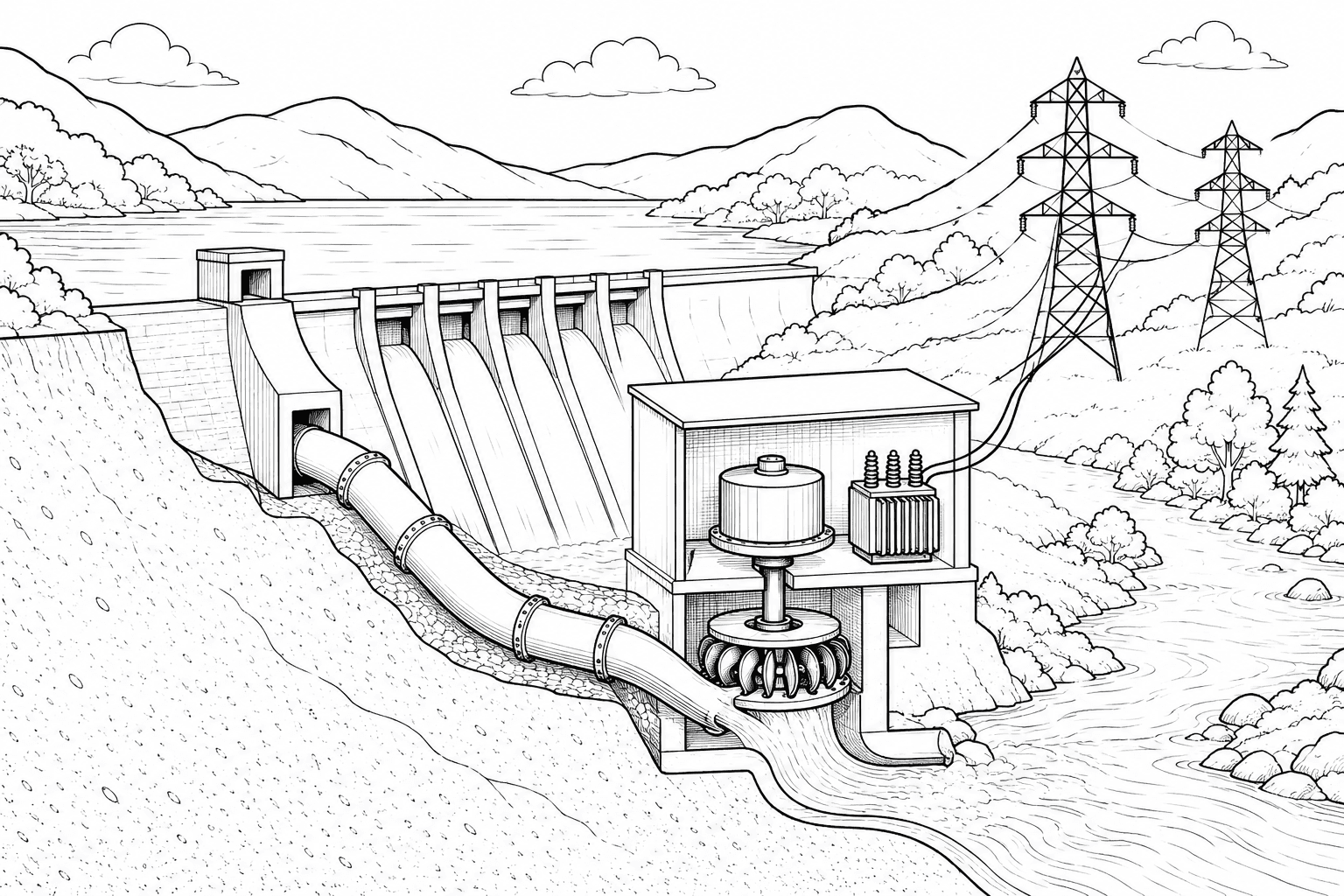
Water is released from the reservoir or channel and allowed to fall through a penstock (a large pipe) onto the blades of a turbine. The force of the falling water spins the turbine, which is connected to a generator that produces electricity. The height the water falls from, known as the "head," and the volume of water flowing, known as the "flow rate," together determine how much electricity a plant can generate.
Conventional hydropower is generally divided into two categories based on how the water is stored and released:
Impoundment (Dam-based) – The most familiar type, where a large dam stores water in a reservoir. Water is released through turbines as needed, giving operators precise control over when electricity is generated, making it especially valuable for meeting sudden spikes in demand.
Run-of-River – Instead of storing large volumes of water, run-of-river plants use the natural flow and elevation drop of a river with little or no reservoir. These systems have a smaller environmental footprint since they don't flood large areas of land, but their output fluctuates with the river's natural flow and seasonal rainfall.
Pumped Storage Hydropower
Have you ever wondered how the grid balances excess solar and wind power generated during the day with demand at night? That's where pumped storage hydropower comes in.
Pumped storage hydropower works like a giant rechargeable battery. Instead of only converting the energy of falling water into electricity, it also uses surplus electricity to pump water back uphill so it can be reused later.
The process involves two reservoirs at different elevations. During periods of low electricity demand or excess renewable generation, surplus power is used to pump water from the lower reservoir up to the higher one. When electricity demand rises, the stored water is released back down through turbines to generate power, just like a conventional hydropower plant.
Pumped storage is becoming one of the fastest-growing segments of hydropower because it can store energy for hours or even days, helping grids absorb the ups and downs of solar and wind generation. It can also be used for other grid-balancing functions such as frequency regulation and providing backup power during outages.
Conventional hydropower is the most common application for large-scale as well as regional electricity generation, so let's understand in more depth how the system works.
How a hydroelectric power system works
The dam or diversion structure is the fundamental component of most hydropower systems. It controls the flow of water and, in impoundment systems, creates the reservoir that stores water for later use. Dams come in various sizes, from small run-of-river structures to massive multipurpose dams that also serve irrigation and flood-control functions.
The penstock is a large enclosed pipe that channels water from the reservoir down to the turbines. The steeper and taller the drop, the more energy the falling water carries by the time it reaches the turbine.
Turbines are the mechanical heart of the system. As water rushes through the penstock and strikes the turbine blades, it causes the turbine shaft to spin. Common turbine types include Francis turbines (used in most medium- to high-head dams), Kaplan turbines (suited to low-head, high-flow rivers), and Pelton turbines (used for very high-head, low-flow sites).
The spinning turbine shaft is connected to a generator, which converts this mechanical rotation into electrical energy through electromagnetic induction, much like the generators used in other power plants.
Hydroelectric generators typically produce Alternating Current (AC) electricity directly, unlike solar PV systems which produce DC. This electricity then passes through a transformer, which steps up the voltage so it can be efficiently transmitted over long distances through transmission lines to substations, and eventually to homes and businesses.
Spillways are an essential safety feature of dams, allowing excess water to be released safely during periods of heavy rainfall or flooding, preventing the dam from being overwhelmed.
Now, let's take a look at some applications of hydroelectric power systems.
1. Large Utility-Scale Hydropower Plants: These are massive dam projects, often built on major rivers, designed to supply electricity to the grid on a national or regional scale. They frequently serve multiple purposes beyond electricity generation, including irrigation, flood control, and water supply for cities and agriculture.
2. Small and Micro-Hydropower Systems: Smaller-scale systems, typically under 25 MW, are well-suited to remote or hilly regions where a large dam isn't feasible. These systems can provide decentralized power to villages and communities not well connected to the main grid.
3. Pumped Storage Plants: As grids integrate more solar and wind power, pumped storage plants are increasingly used purely for energy storage and grid balancing rather than continuous generation, storing surplus renewable energy and releasing it when demand peaks.
Challenges of hydroelectric energy
1. Environmental and Ecological Impact: Large dams can significantly alter river ecosystems, blocking fish migration routes and changing water temperature and sediment flow downstream. Reservoirs also submerge large areas of land, which can affect local wildlife habitats.
2. Displacement of Communities: Building large reservoirs often requires flooding inhabited areas, which can displace communities and require significant resettlement efforts.
3. Dependence on Rainfall and River Flow: Hydropower generation can fluctuate with seasonal rainfall and droughts. In years of low rainfall, reservoir levels drop and electricity output can fall well below capacity.
4. High Upfront Cost and Long Construction Time: Large hydropower projects require substantial capital investment and can take many years, sometimes over a decade, to plan and construct, though they typically have very long operational lifespans of 50 to 100 years once completed.
5. Limited Suitable Sites: Not every region has rivers with the right combination of water flow and elevation drop needed to generate significant electricity, which limits where large hydropower plants can be built.
Hydroelectric energy in India
India has a long history with hydropower, with some of its earliest plants, at Darjeeling and Shivanasamudra, established in 1898 and 1902 respectively, among the first in Asia. Today, hydroelectric power remains a significant part of India's energy mix, alongside its rapidly growing solar and wind capacity.
India's total installed power generation capacity stood at around 533 GW as of early 2026, with large hydro and small hydro projects together contributing a meaningful share of the renewable mix. India's economically exploitable hydroelectric potential is estimated at close to 148,700 MW, and the country ranks fourth in the world by undeveloped hydropower potential, behind only Russia, China, and Canada.
The public sector plays a dominant role in India's hydropower sector, with organizations like the National Hydroelectric Power Corporation (NHPC), Satluj Jal Vidyut Nigam (SJVNL), THDC, and NTPC-Hydro operating many of the country's major plants. Some of India's largest hydroelectric projects include the Tehri Dam and the Bhakra Dam, the latter forming the Gobind Sagar Reservoir, one of the largest freshwater reservoirs in the country.
Pumped storage hydropower is emerging as a major growth area for India. The country currently has close to 5 GW of pumped storage capacity, with ambitious plans to scale this up to as much as 100 GW by 2035 as India looks to balance its expanding solar and wind fleets with reliable, long-duration storage.
Small hydropower is also seeing renewed government attention. Projects with capacity up to 25 MW currently contribute around 5 GW nationally, and there have been reports of plans to revive dedicated small hydropower schemes targeting further capacity additions in hilly and border regions, with an aim to roughly double small hydro capacity over the coming decade.
Frequently Asked Questions:
1. How does a hydroelectric power system work?
Flowing or falling water spins a turbine connected to a generator, which converts the mechanical energy into electricity that is then transmitted through transformers and power lines.
2. What are the main types of hydropower?
Conventional hydropower (impoundment and run-of-river) and pumped storage hydropower, which stores energy by moving water between two reservoirs at different elevations.
3. What are the applications of hydroelectric power systems?
Large utility-scale dams, small and micro-hydropower systems for remote areas, and pumped storage plants for grid balancing and energy storage.
4. What are the main challenges of hydroelectric energy?
Environmental and ecological impact, community displacement, dependence on rainfall, high upfront costs, and limited suitable sites.
5. What is India's hydropower potential?
India's economically exploitable hydroelectric potential is estimated at around 148,700 MW, with the country also emerging as a global leader in pumped storage development.


