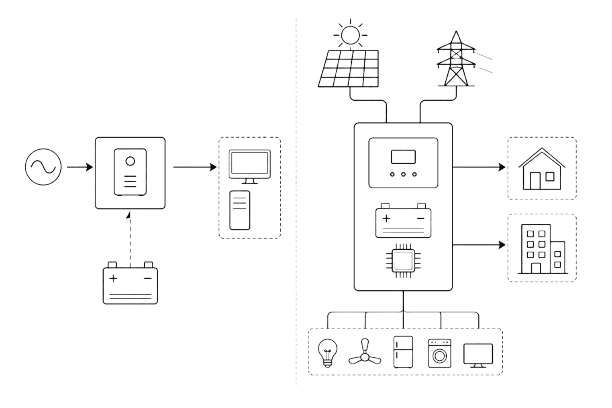
If you have ever shopped for backup power, you have probably come across two terms that get used a lot: UPS and Battery Energy Storage System (BESS). At first glance, they seem to do the same job keeping your power running when the grid goes down. Technically, both store energy in a battery and release it when needed. However, that is where the similarity ends.
A traditional UPS is designed to provide backup power for a few minutes. A Battery Energy Storage System is designed to power your home or business for several hours. One acts as a safety net, while the other functions more like a secondary power source.
Confusing the two can lead to buying the wrong solution, either spending more than necessary or ending up with a system that does not meet your backup power needs. Let us take a closer look at how they differ.
What Is a Traditional UPS?
UPS stands for Uninterruptible Power Supply. Its primary purpose is to bridge the gap between a power outage and the moment your backup source, such as a generator, starts running. It also gives you enough time to save your work and safely shut down connected devices.
Think about the small UPS unit placed under an office desk or beside a desktop computer. When the power goes out, it beeps and continues supplying power for about 5 to 15 minutes. That is exactly what it is designed to do.
Some key characteristics of a UPS include:
It reacts within milliseconds, so sensitive electronics never notice the power interruption.
The battery is usually small and lead-acid based.
It is designed for short-duration backup rather than extended use.
It is relatively affordable and simple to install.
A UPS is not designed to power an entire home. Instead, it protects critical equipment such as computers, servers, networking devices, and medical equipment from sudden power loss.
What is a battery energy storage system (BESS)?
A Battery Energy Storage System is a much more capable energy solution. Instead of providing backup for only a few minutes, it stores large amounts of electricity and supplies power for several hours or even an entire day, depending on its capacity.
Battery Energy Storage Systems are commonly used in homes with solar panels, businesses looking to reduce electricity costs, and utility-scale projects that help stabilize the electrical grid.
Here are the features that set a Battery Energy Storage System apart:
It uses lithium batteries, most commonly LiFePO4, which have a much longer lifespan than traditional lead-acid batteries.
It stores and delivers significantly more energy than a conventional UPS.
It can work alongside solar systems by storing excess daytime energy for use at night.
It includes an advanced Battery Management System (BMS) that continuously monitors battery temperature, voltage, charging, discharging, and overall health.
The Battery Management System plays a critical role in ensuring safety and performance. A Battery Energy Storage System is much more than simply a larger battery. Without a reliable Battery Management System, a high-capacity lithium battery can become unsafe. The Battery Management System makes long-term, safe energy storage possible.
Battery Energy Storage System vs Traditional UPS
Factor | Traditional UPS | Battery Energy Storage System |
Purpose | Short-term protection during power outages | Long-duration backup and energy storage |
Backup Duration | Minutes | Hours to a full day |
Battery Type | Usually lead-acid | Usually lithium (LiFePO4) |
Typical Applications | Computers, servers, small offices | Homes, businesses, solar installations |
Solar Compatibility | Rarely | Commonly |
Lifespan | 2 to 3 years | 8 to 10 years or more |
Initial Cost | Lower | Higher |
Long-Term Cost | Higher due to battery replacements | Lower because of longer life and energy savings |
Which one is right for you?
The best choice depends entirely on the problem you want to solve.
Choose a traditional UPS if your goal is to protect computers, servers, or sensitive electronics from sudden power interruptions. It is affordable, easy to install, and performs this task extremely well.
Choose a Battery Energy Storage System if you experience frequent or extended power outages, have solar panels, or want to reduce electricity bills by storing energy during off-peak hours and using it during peak demand. Although it requires a larger initial investment, it provides significantly greater functionality and long-term value.
Many homeowners across India are now moving beyond conventional UPS systems and inverters in favor of Battery Energy Storage Systems. Lithium batteries offer longer service life, faster charging, minimal maintenance, and the ability to power an entire home for hours instead of only a few minutes.
The one thing both systems have in common
Whether you choose a traditional UPS or a Battery Energy Storage System, the battery is only as reliable as the system protecting it.
A poorly designed Battery Management System is one of the most common causes of battery failures, including overheating, overcharging, deep discharging, and premature cell degradation.
When comparing backup power solutions, do not focus only on battery capacity or price. Ask about the quality of the Battery Management System, its safety features, and who manufactures it. A high-quality Battery Management System is often the difference between a battery that lasts only a few years and one that performs reliably for a decade or more.
Frequently Asked Questions
1. What is the main difference between a UPS and a Battery Energy Storage System (BESS)?
A UPS provides short-term backup power, typically between 5 and 15 minutes, to protect electronic devices during sudden outages. A Battery Energy Storage System stores much larger amounts of energy and can power homes or businesses for several hours.
2. Can a Battery Energy Storage System replace a traditional UPS?
Yes. In many applications, a Battery Energy Storage System can provide uninterrupted power while also delivering long-duration backup. However, equipment that requires absolutely zero interruption may still benefit from a dedicated UPS.
3. Is a Battery Energy Storage System compatible with solar panels?
Yes. Most Battery Energy Storage Systems are designed to work seamlessly with solar installations, allowing excess daytime energy to be stored for use during the night or during power outages.
4. Why are lithium batteries preferred in Battery Energy Storage Systems?
Lithium batteries, especially LiFePO4 batteries, provide longer lifespan, faster charging, higher efficiency, better energy density, and require very little maintenance compared to traditional lead-acid batteries.
5. How long does a Battery Energy Storage System last?
A high-quality lithium-based Battery Energy Storage System typically lasts between 8 and 10 years or even longer, depending on battery chemistry, usage patterns, and the quality of the Battery Management System.


