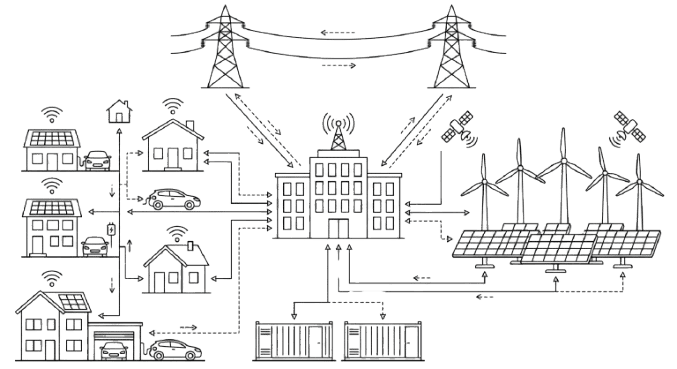
Renewables are all the craze nowadays, but as solar and wind capacity scales up, grids everywhere face a new challenge: the sun doesn't shine at night and the wind doesn't always blow when demand peaks. Grid-Scale Battery Energy Storage Systems, or BESS, are quickly becoming the answer to this problem. Let's look at what it is.
Storing Electricity at the Scale of a Power Plant
Basically, a Grid-Scale BESS is exactly what its name implies: a battery installation large enough to store and release electricity at the scale of a power plant, directly connected to the transmission or distribution grid rather than sitting behind a home or business meter. These "front-of-the-meter" systems typically range from a few megawatts to multiple gigawatt-hours of capacity, and their job is to absorb surplus electricity when it's abundant and release it back to the grid the moment it's needed.
Unlike pumped hydro storage, which needs specific geography (a hill, a reservoir, years of construction), a BESS installation is modular. Shipping-container-sized battery enclosures can be engineered, deployed, and commissioned in months rather than years, which is a large part of why battery storage has overtaken pumped hydro as the fastest-growing form of grid storage worldwide.
Globally, the numbers reflect just how quickly this has scaled: in the first nine months of 2025 alone, roughly 49.4 GW and 136.5 GWh of grid-scale BESS came online worldwide, a 36% jump over the same period the year before. In India specifically, Adani Green Energy commissioned a cumulative 3.37 GWh BESS at Khavda, Gujarat, in 2026, described as the largest single-location battery storage deployment outside China, and the company plans to scale this to 50 GWh over the next five years.
Standalone BESS
Standalone BESS projects are battery installations that operate independently of any specific generation source. Rather than being tied to a single solar or wind farm, these systems act as their own service provider to the grid, buying cheap power when it's abundant and selling it back, or providing grid-support services, when it's valuable.
Standalone systems are particularly useful for pure energy arbitrage (charging when electricity is cheap and discharging when it's expensive) and for grid services like frequency regulation, where the battery needs to respond in milliseconds regardless of what any single power plant is doing nearby. Because they aren't tied to one generation asset, standalone BESS can also be positioned strategically on the grid, wherever transmission congestion or demand patterns make them most valuable, rather than only where a solar or wind farm happens to be located.
Hybrid BESS (RE + Storage)
Have you ever heard of the "duck curve," the dip in net electricity demand during the sunny midday hours followed by a steep evening ramp as solar output falls away just as people get home and switch on their appliances? That's exactly the problem hybrid BESS projects are built to solve.
A hybrid BESS is co-located with a renewable energy plant, typically solar or wind, and captures the surplus power generated during peak production hours for release later when demand is high but generation has dropped off. This is often structured as a Firm and Dispatchable Renewable Energy (FDRE) contract, where the combined solar-plus-storage or wind-plus-storage project commits to supplying power on a defined schedule rather than only whenever the sun happens to shine or the wind happens to blow.
Hybrid projects also help reduce renewable curtailment, the practice of deliberately switching off solar or wind generation because the grid can't absorb it at that moment, and they make better use of existing transmission infrastructure by storing power when transmission capacity is unavailable and releasing it when capacity opens up.
Standalone and hybrid BESS together are increasingly seen as the two core buckets driving India's storage buildout, so let's understand in more depth how a grid-scale battery system actually works.
How a Grid-Scale BESS Works
The battery system is the chemical core of any BESS installation. In most utility-scale deployments today, Lithium Iron Phosphate (LFP) chemistry dominates, prized for its safety, efficiency, and falling costs compared to other lithium-ion chemistries.
Battery cells are grouped into modules, and modules are grouped into racks, which are then housed inside weatherproof enclosures, commonly shipping-container-sized units, that protect the system from the elements and provide thermal management.
The Battery Management System (BMS) monitors every cell's voltage, temperature, and current in real time, balancing charge across cells and shutting the system down safely if it detects a fault. A poorly performing BMS can be costly. In one documented real-world case, a 350 MWh battery storage system lost roughly 11% of its usable capacity to undetected imbalance, silently inflating balancing costs for its operator.
The Power Conversion System (PCS), also called the inverter, converts the battery's stored Direct Current (DC) electricity into Alternating Current (AC) for the grid, and converts incoming AC back to DC when the battery is charging.
The Energy Management System (EMS) acts as the brain of the installation. By continuously monitoring real-time grid parameters, the EMS decides exactly when the system should charge or discharge, ensuring it responds instantly to grid operator instructions and market signals.
Finally, a transformer and grid interconnection equipment step the battery's output voltage up to match the transmission or distribution network, and handle the safety and metering requirements for connecting to the wider grid.
Now, let's take a look at some applications of Grid-Scale BESS.
1. Frequency and Voltage Regulation: Because batteries can respond in milliseconds, far faster than a traditional fossil-fuel power plant can ramp up or down, BESS is uniquely suited to keeping grid frequency and voltage stable moment to moment.
2. Peak Shaving and Renewable Firming: BESS absorbs surplus midday solar generation and shifts it to the evening peak, smoothing out the mismatch between when renewable power is generated and when it's actually needed, and reducing reliance on fossil-fuel peaker plants.
3. Backup Power for Mission-Critical Loads: Grid-scale batteries increasingly serve as an uninterruptible power supply for critical infrastructure, and are being deployed alongside AI data centers, which are placing unprecedented new demands on grid capacity.
Challenges of Grid-Scale BESS
1. Underbidding and Pricing Pressure: As BESS tenders have multiplied, bid tariffs have fallen sharply, in some Indian auctions by over 40% year-on-year, raising concerns among lenders and developers that some projects may be underbid relative to their true long-term costs.
2. Delays in Power Purchase Agreements and Grid Connection: BESS projects are typically given 18 to 24 months to reach commissioning after a Power Purchase Agreement is signed, but PPA signing itself is often delayed as offtakers wait for further price declines, while renewable capacity growth is also outpacing transmission infrastructure buildout in many regions.
3. Battery Fire and Safety Risk: As deployment accelerates, insurers are increasingly scrutinizing risks around transformers and contractor installation errors, since a fire in a densely packed battery enclosure can be difficult to contain and can damage neighboring units.
4. Cybersecurity Vulnerabilities: Because modern BESS installations are software-controlled and grid-connected, they are increasingly being tested against a range of local and remote cyberattack vectors, an emerging concern as more of the grid's stability comes to depend on networked battery systems.
5. High Upfront Capital Costs: Even with falling battery prices, utility-scale BESS still requires significant capital investment, with all-in capex for a four-hour system estimated at around $125 per kWh in markets outside China and the United States.
Grid-Scale BESS in India
India's BESS story has moved fast. As of December 2025, a total of 224 GWh of energy storage capacity had been tendered nationally, including 92 GWh of BESS and 132 GWh of pumped hydro, though as of February 2026 only around 0.8 GWh of BESS was actually operational, with roughly 6 GWh more expected online by the end of 2026.
The Central Electricity Authority estimates India will need 411.4 GWh of total energy storage by 2031-32, split between 236.2 GWh of BESS and 175.2 GWh of pumped hydro, while a separate Indian Energy Storage Alliance whitepaper projects cumulative stationary storage capacity could reach 346 GWh by 2033 under a base scenario, or as much as 544 GWh if policy momentum continues.
This growth is being driven by a deliberately layered policy framework built over the past few years. The government has introduced ₹91 billion (about $1.09 billion) in Viability Gap Funding to support 43.2 GWh of BESS capacity, allowing individual standalone projects to access up to 40% of their capital costs as a grant. Energy Storage Obligations now require DISCOMs to progressively procure storage-backed power, starting at 1% of supply in FY2024-25 and rising to 4% by FY2029-30, with Rajasthan moving even faster, targeting 3% by FY2026-27. BESS projects co-located with renewable plants and commissioned by June 2028 are also exempt from interstate transmission charges, and the Union Budget 2026-27 introduced targeted customs duty exemptions for BESS manufacturing inputs.
On the manufacturing side, over 200 GWh of battery manufacturing capacity is planned across Indian conglomerates by 2030, aimed at reducing the country's current dependence on imported cells, a vulnerability that policymakers see as central to whether India can deploy storage at the pace its grid now requires.
Frequently Asked Questions:
1. How does a Grid-Scale BESS work?
Battery cells store electricity in chemical form; a Battery Management System monitors cell health, a Power Conversion System converts between DC and AC, and an Energy Management System decides when the battery charges or discharges based on grid needs.
2. What is the difference between standalone and hybrid BESS?
Standalone BESS operates independently, providing arbitrage and grid services regardless of any single generation source, while hybrid BESS is co-located with a solar or wind plant to firm up renewable output and reduce curtailment.
3. What are the applications of Grid-Scale BESS?
Frequency and voltage regulation, peak shaving and renewable firming, and backup power for mission-critical loads such as data centers.
4. What are the main challenges of Grid-Scale BESS?
Underbidding and pricing pressure, PPA and grid-connection delays, battery fire and safety risk, cybersecurity vulnerabilities, and high upfront capital costs.
5. How much BESS capacity does India need?
The Central Electricity Authority estimates India will need 236.2 GWh of BESS capacity by 2031-32, with industry projections suggesting cumulative installed storage could reach 346 GWh or more by 2033.


