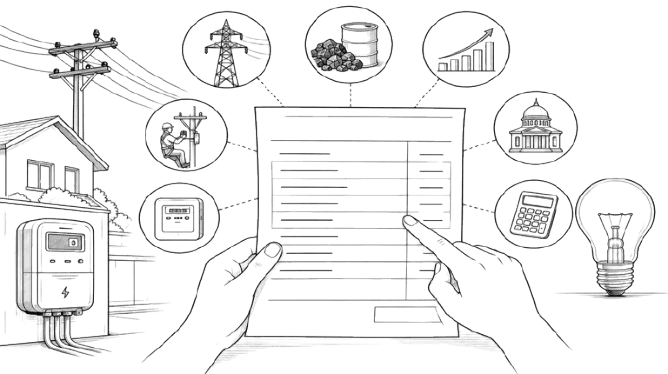
You open your electricity bill expecting one number what you owe and instead find a maze of terms: fixed charges, energy charges, fuel surcharge, taxes, and a handful of abbreviations that mean nothing at a glance. You are not alone. Most people pay the total without ever knowing what they are actually paying for.
This guide breaks down every major component of a typical electricity bill so you can read yours with confidence, and maybe even spot ways to bring the number down.
Why your bill is not just "One Charge"
Electricity pricing is built in layers because different parts of the cost structure behave differently. Some costs stay the same no matter how much power you use. Others scale directly with your consumption. And some shift monthly based on fuel prices the utility cannot control. Splitting these out is how utilities keep pricing transparent even if it does not always feel that way.
Let us go through each layer.
1. Fixed Charges (or Demand Charges)
This is the amount you pay simply for being connected to the grid regardless of how many units of electricity you actually consumed that month.
What it covers:
Maintaining the wires, poles, and transformers that reach your home
Meter reading and billing infrastructure
Grid availability, so power is ready the instant you flip a switch
How it is calculated: Fixed charges are usually based on your sanctioned load or contract demand (measured in kW or kVA), not your actual usage. A home with a 5 kW sanctioned load pays a set fixed charge whether it uses 50 units or 500 units that month.
Why it exists: Even a vacant house on a billing cycle with zero consumption still costs the utility money to keep connected. Fixed charges recover that baseline cost.
2. Energy Charges
This is the part most people think of as "the real bill" the cost of the actual electricity you consumed, measured in kWh (units).
How it is calculated: Energy charges usually follow a slab (tiered) structure. The more you consume, the higher the rate per unit in the upper slabs. A simplified example:
Units Consumed | Rate per Unit |
0–100 | ₹3.50 |
101–200 | ₹4.50 |
201–300 | ₹6.00 |
Above 300 | ₹7.50 |
This means your bill is not one flat rate multiplied by total units each slab is charged at its own rate, and the amounts are added together.
Why slabs exist: Tiered pricing is designed to keep essential electricity affordable for low-usage households while charging heavier users more, since higher consumption also means higher generation and distribution costs.
3. Fuel Surcharge (or Fuel Adjustment Charge)
This is the most misunderstood line item and often the most variable one.
What it is: Fuel surcharge is a pass-through cost. Utilities buy coal, gas, or other fuel to generate electricity, and those fuel prices fluctuate month to month. Rather than revising the entire tariff structure every time fuel costs shift, utilities add a variable surcharge (or occasionally a rebate) to reflect the current cost of fuel.
Why it changes every month:
Global fuel and coal prices move up or down
Seasonal demand affects how much power plants need to generate
Transmission losses and short-term power purchases add cost
Why it is separate from energy charges: If fuel costs were baked into the base tariff, utilities would need regulatory approval to change rates constantly. Keeping it as a separate surcharge lets pricing respond faster to real-world fuel cost changes without renegotiating the entire tariff.
4. Taxes and Duties
Like most utility bills, electricity bills include government-mandated charges layered on top of the base cost.
Common components:
Electricity duty — a state-level tax charged as a percentage of your total bill or per unit consumed
Municipal tax — in some regions, local municipal bodies levy an additional charge
GST or equivalent — applicable on certain components in some jurisdictions, though electricity itself is exempt from GST in many countries
These taxes typically apply after fixed charges, energy charges, and surcharges are totaled, meaning they are calculated on the subtotal rather than as a flat fee.
5. Other line items you might see
Meter rent — a small monthly fee for the meter itself, especially if it is a smart or prepaid meter
Power factor penalty/incentive — mostly on commercial or industrial bills, this rewards or penalizes how efficiently you draw power
Arrears — unpaid balance carried over from a previous billing cycle
Subsidy adjustment — a reduction applied if you qualify for a government electricity subsidy
What this means for you
Understanding this breakdown is not just academic it changes how you think about saving money:
Cutting usage lowers your energy charges, but your fixed charges stay the same no matter what. If your bill still feels high despite low usage, the fixed charge is likely the reason.
Fuel surcharge is largely outside your control. It reflects market fuel prices, not your consumption habits, so do not be alarmed if it rises even when your usage drops.
Slab-based pricing rewards staying just under the next threshold. Shaving a few units off your monthly usage near a slab boundary can meaningfully reduce your rate for that entire tier.
Taxes scale with everything above them, so reducing your energy charges also slightly reduces the tax you pay on top.
Final Thought
Your electricity bill is not arbitrary it is a structured reflection of infrastructure costs, actual consumption, fuel market realities, and government levies, all itemized for transparency. Once you know what each line represents, the bill stops being a confusing wall of numbers and starts being a useful tool for managing your energy costs.
Frequently Asked Questions:
1. Why do I have to pay a fixed charge even if I used zero electricity? Fixed charges cover the cost of keeping your connection active maintaining wires, transformers, and meters regardless of consumption. It is a cost for availability, not usage.
2. Why does my fuel surcharge change every month even though my usage is the same? The fuel surcharge reflects the real-time cost of coal, gas, or other fuel the utility buys to generate power. Since fuel prices fluctuate with the market, this charge moves independently of how much electricity you use.
3. What is the difference between energy charges and fuel surcharge? Energy charges are the base cost of the electricity you consumed, priced by slab. The fuel surcharge is an additional, variable amount added on top to account for changing fuel costs it is not part of the base tariff.
4. Why is my bill charged in slabs instead of one flat rate? Slab (tiered) pricing charges lower rates for essential, low-level usage and higher rates as consumption increases. It is designed to keep basic electricity affordable while charging heavier users proportionally more.
5. Can I reduce my fixed charges by using less electricity? No. Fixed charges are based on your sanctioned load/contract demand, not actual usage. Only energy charges (and the taxes calculated on them) go down when you consume less.


