Understanding Smart Meters and a Look into Its Impact on the Grid
There is a shift happening in the global energy landscape, as we discussed in previous articles, there is a need for efficiency, sustainability, and integration of renewable energy sources. Now this shift has prompted the integration of many smart devices to modernize the grid, one such device is a Smart Meter.
Electricity isn’t free, so your usage needs to be billed regularly. That’s why every connection needs a meter.
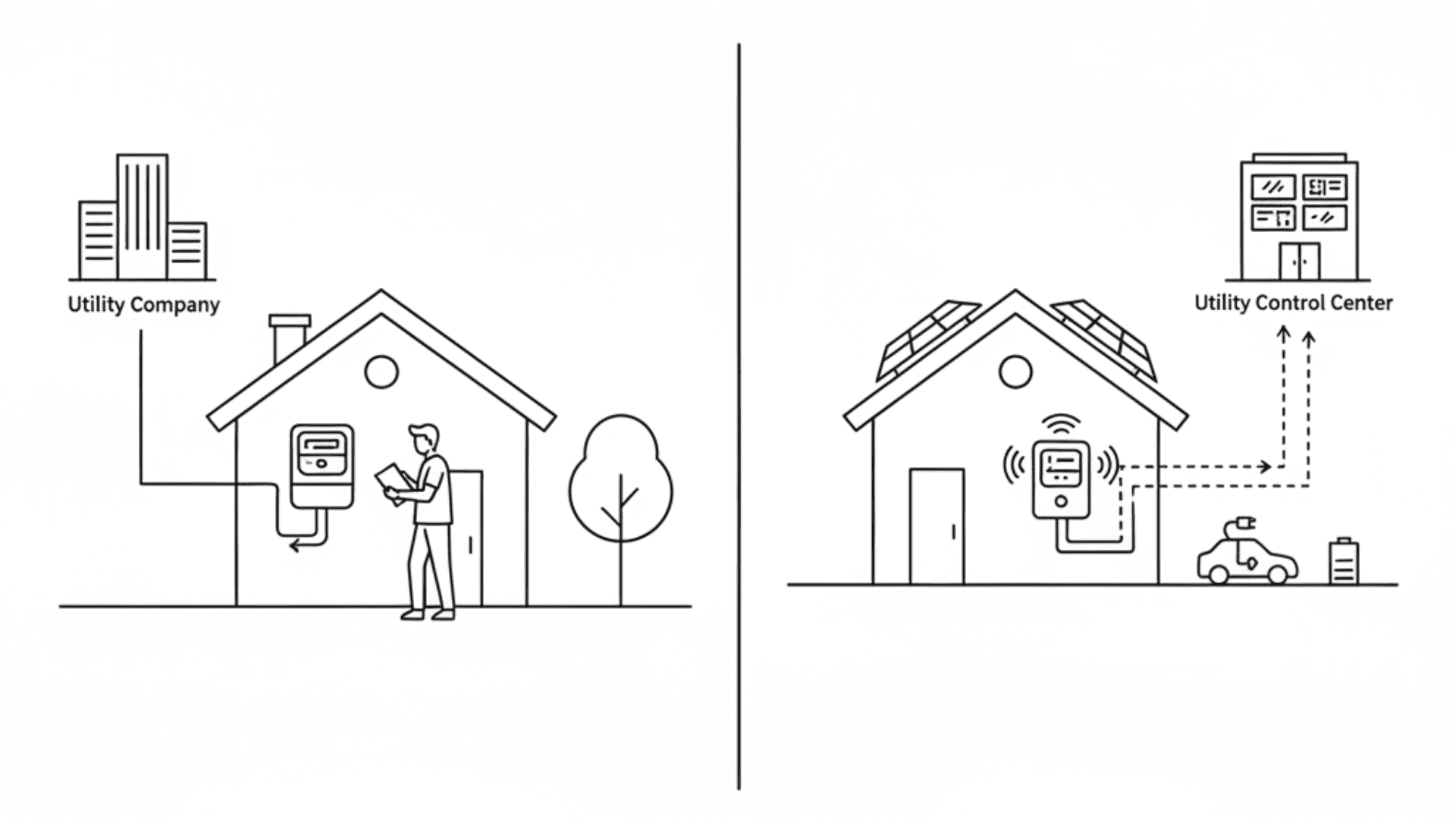
We all have seen electricity meters in our house, right? They show us the amount of electricity we consume, these devices are often manual. They require meter readings to be inspected physically for power generation. Hence, these meters offer only one-way communication, which means, it records the amount of electricity consumed and that’s it.
Smart Meters, on the other hand, are far more flexible, they enable real-time monitoring, analysis, and management of energy consumption.
Hey!, don’t freak out hearing the word “real-time monitoring”, let me explain – smart meters allow consumers to monitor their energy consumption in real-time, helping them identify high-usage periods and appliances.
Now with such a detailed look into your consumption, consumers can make informed decisions about how to reduce their consumption and lower their energy bills.
Since energy consumption can be monitored in real time, consumers are also incentivized to reduce or shift their electricity usage during peak periods. This helps balance supply and demand, reducing strain on the grid.
Sounds cool right? There’s even more – These devices enable two-way communication between the consumer and the utility, where the utility sends and receives data, including remote meter readings and updates.
This two-way communication is very important in a smart grid. Check out this article we wrote to learn more about smart grids.
Because of this communication, Utilities can use smart grid data to forecast the demand growth in the network and accurately plan the laying of new lines and upgrading transformer capacities.
Smart meters can also detect power outages or irregularities in energy flow, enabling faster identification and resolution of issues.
By analyzing usage patterns, smart meters can help utilities identify potential cases of energy theft, improving overall revenue collection.
The increase in renewable energy generation has introduced variability into the energy supply. Smart meters enable better management of this variability by providing data on production and consumption patterns, ensuring grid stability.
With the percentage of EVs also on the rise, smart meters will enable utilities to incentivize consumers to sell stored power from batteries back to the grid to meet any increase in demand.
Smart meters also play a role in both net metering and gross metering, enhancing efficiency, accuracy, and transparency in energy management.
To understand this, let's understand Net and Gross metering –
Net Metering: Net metering is a system that allows domestic or commercial users who generate their electricity using solar energy systems to export their surplus energy back to the grid. This allows system owners the opportunity to gain extra revenue by selling their excess power to the grid while also making up for shortfalls in the grid.
In this case, smart meters can measure both the energy consumed from the grid and the energy exported back to the grid by the consumer’s renewable energy system, enabling precise calculation of "net" energy usage, and ensuring accurate billing.

Gross Metering: In contrast to net metering, the consumer does not directly use the solar power generated. Instead, all the electricity produced by the solar panels is exported to the grid, while the consumer imports all their electricity needs from the grid. This setup requires two separate electric meters: one to measure the power imported and the other to measure the power exported. Additionally, the rate at which consumers sell power back to the grid (determined by the utility) is lower than the rate at which they buy power from the grid. Due to this tariff difference, consumers can only reduce their electricity bills to some extent.
In this case, smart meters provide real-time data on the amount of electricity exported to the grid, this ensures accurate tracking of energy sold to the utility.

Smart Meters in India
India’s power sector faces challenges like energy theft, billing inefficiencies, and high transmission and distribution (T&D) losses. Smart meters are seen as a solution to these issues by providing accurate billing, enabling better load management, and reducing revenue losses for utilities. To promote Smart Meters and Modernize the grid, the government has implemented various initiatives, let's take a look -
1. Smart Meter National Programme (SMNP): This is an initiative by the Government of India to promote the adoption of smart meters nationwide. The program aims to replace 25 crore traditional meters with smart meters across the country. It is being implemented by Energy Efficiency Services Limited (EESL) under the Build-Own-Operate-Transfer (BOOT) model.
Under this model, EESL bears all the capital and operational expenses, requiring no upfront investment from states or utilities. The costs are recovered through the monetization of energy savings achieved via improved billing accuracy, elimination of manual meter reading costs, and other operational efficiencies.
2. Revamped Distribution Sector Scheme: This is an initiative aimed at reducing AT&C (Aggregate Technical and Commercial) losses to 12-15% on a pan-India basis. The initiative has a budget allocation of ₹3,03,758 crore for five years, from FY 2021-22 to FY 2025-26, and involves the deployment of prepaid smart meters and system metering to improve billing accuracy, reduce theft, and enable real-time monitoring.
3. National Smart Grid Mission (NSGM): This was established by the Government of India in 2015 to plan and monitor the implementation of policies and programs related to Smart Grid activities in India. The primary aim of the Smart Grids is to improve the reliability of the Electricity networks and make the grid amenable to renewable energy inputs through distributed generation.
Now, smart meters are not the only device consumers can use to enhance energy efficiency and save cost. We at Xbattery offer another solution.
Our high-performance lithium battery pack, that is specifically designed for our country. This 5kWh battery pack provides backup power for your home, keeping essential devices like lights, fans, fridge, TV, laptops, and other appliances running for up to a day during power outages.
Need more backup? No problem! Our systems are modular, just like Legos, simply add more packs for extra storage. The more packs you add, the more power you can store. With the right configuration, you can even power your EV.
The best part? The system’s intelligent modes kick in before the power goes out, ensuring you stay powered through any disruption. It is even compatible with your existing solar energy system.
Frequently Asked Questions:
1. How is a smart meter different from a traditional electricity meter?
Traditional meters only measure energy use and require manual readings. Smart meters allow real-time monitoring, send automatic readings, and support advanced features like usage alerts and dynamic pricing.
2. How do smart meters help consumers save money?
Smart meters show how and when you use electricity. This helps you identify high-usage appliances or time periods, so you can adjust your habits and lower your bills.
3. Can smart meters help reduce power outages?
Yes, smart meters can quickly detect outages and irregularities in electricity flow. This allows utility companies to respond and restore power faster.
4. What is two-way communication in smart meters?
Two-way communication means the meter not only sends data to the utility but can also receive commands, updates, or pricing info. This improves grid reliability and user control.


