1. Introduction
Battery Management Systems sit at the intersection of electrochemistry, embedded systems, and control theory, and they are increasingly the deciding factor in whether an energy storage deployment succeeds or fails. Across electric vehicles, grid-scale storage, industrial UPS systems, consumer electronics, and renewable energy integration, the battery pack is only as capable as the intelligence managing it. The lithium-ion (Li-ion) and lithium iron phosphate (LiFePO4) chemistries that dominate modern deployments offer high energy density, low self-discharge, and long cycle life but they are also highly sensitive to overcharge, over-discharge, excessive temperature, and internal resistance growth. Left unmanaged, these degradation pathways reduce usable capacity, shorten service life, and in extreme cases trigger thermal runaway, a catastrophic failure mode with serious safety consequences.
The Battery Management System is the electronic subsystem responsible for preventing these outcomes. A BMS continuously monitors voltage, current, and temperature across individual cells and the pack as a whole; estimates abstract internal states such as State of Charge (SOC) and State of Health (SOH) that cannot be observed directly by any sensor; balances cell-to-cell charge disparities that would otherwise accelerate aging; enforces safe operating limits on charge and discharge; and communicates state information to the host system, whether a vehicle controller, grid inverter, or industrial controller. The accuracy and latency of BMS state estimation directly determine how efficiently energy can be extracted, how reliably remaining capacity can be predicted, and how long the pack survives in service.
Traditional BMS firmware relies on physics-based or empirical models extended Kalman filters, equivalent circuit models, and Coulomb counting that are computationally frugal but increasingly insufficient for the nonlinear, temperature-dependent, aging-sensitive behaviour of real-world battery packs. Meanwhile, the explosion of machine learning has produced architectures such as LSTM networks, CNNs, GRUs, and Temporal Convolutional Networks (TCNs) capable of capturing complex spatiotemporal patterns in battery data with high accuracy. The challenge is deploying these models in the constrained embedded environments where BMS hardware actually operates, without introducing cloud dependence that adds latency, bandwidth costs, and single points of failure.
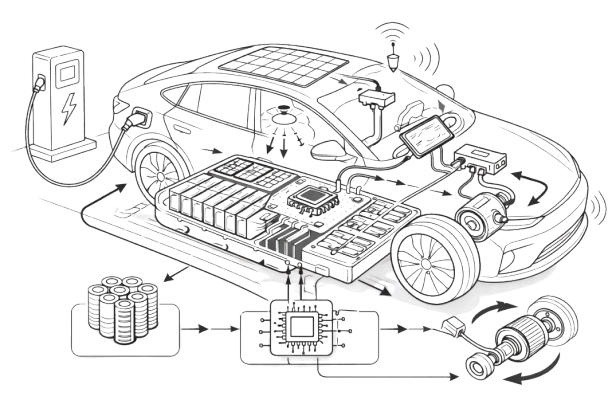
Edge AI addresses this challenge by executing ML inference directly on low-power hardware co-located with the battery pack. By eliminating round-trip cloud latency which can run to hundreds of milliseconds and removing the bandwidth demands of continuous sensor streaming, Edge AI enables real-time BMS decisions at sub-millisecond timescales, with full data privacy and operational resilience in connectivity-poor environments. The emergence of next-generation neural decision processors ultra-low-power inference chips capable of running deep neural networks at sub-milliwatt power budgets makes this vision practically realisable across the full spectrum of BMS deployment contexts, from automotive packs to grid storage cabinets to handheld devices.
2. Battery Fundamentals: States, Degradation, and Definitions
2.1 State of Charge (SOC)
The State of Charge represents the ratio of the battery's currently available capacity to its fully charged rated capacity, expressed as a percentage. SOC cannot be measured directly by any sensor terminal voltage, current, and temperature all exhibit indirect, nonlinear relationships with SOC that vary with temperature, aging, and discharge rate, making accurate estimation a nontrivial engineering problem.
The most mathematically transparent estimation method is Coulomb counting (ampere-hour integration):
$$ SOC(t) = SOC(t_0) + \frac{1}{C_{\text{rated}}} \int_{0}^{t} I_b \, d\tau $$where SOC(t₀) is the initial state of charge, C_rated is the rated nominal capacity in ampere-hours, and I_b is the measured battery current (positive for charging, negative for discharging). Accuracy is critically dependent on the initial SOC estimate and current sensor precision; integration errors accumulate over time, a phenomenon known as drift.
A more refined formulation accounts explicitly for loss currents:
$$ SOC(t) = SOC(t_0) + \frac{1}{C_{\text{nom}}} \int [I_{\text{bat}}(\tau) - I_{\text{loss}}(\tau)] \, d\tau \times 100\% \quad (CC\text{-}2) $$where I_bat is the battery terminal current, I_loss aggregates all parasitic current draws, and C_nom is the nominal capacity.
2.2 State of Health (SOH)
State of Health reflects the long-term degradation of the battery across many cycles. The primary capacity-based definition is:
$$ SOH(t) = \frac{C_{\text{eff}}(t)}{C_{\text{nom}}} \times 100\% \quad (SOH\text{-}1) $$A battery is typically considered to have reached end-of-life when its SOH falls below 80%. A resistance-based SOH definition, useful for online estimation, is:
$$ SOH_{b,k} = \frac{R_{\text{EoL}} - R_{b,k}}{R_{\text{EoL}} - R_{\text{fresh}}} \quad (SOH\text{-}2) $$where R_EoL is the internal resistance at end-of-life, R_fresh is the initial resistance of a new cell, and R_{b,k} is the measured resistance at cycle k. As the battery ages, R_{b,k} increases toward R_EoL and the SOH metric decreases toward zero.
2.3 Battery Degradation Mechanisms
Li-ion and LiFePO4 battery degradation is driven by two primary mechanisms. Capacity fade refers to the gradual irreversible reduction in storable charge, caused primarily by loss of active lithium inventory trapped in the solid-electrolyte interphase (SEI) layer and by depletion of active electrode material through structural changes or particle cracking. Power fade refers to the increase in internal resistance with aging, limiting peak current capability for both acceleration and regenerative braking. A battery in an EV is expected to remain serviceable (SOH > 80%) for 8 to 15 years or 1,000 to 3,000 full cycles, depending on chemistry, thermal management quality, and depth-of-discharge profiles.
2.4 Open-Circuit Voltage Method
The Open-Circuit Voltage (OCV) method estimates SOC by measuring the battery's terminal voltage after allowing it to rest long enough for polarisation effects to dissipate. The stabilised OCV is mapped to SOC via a pre-characterised curve. Its fundamental limitation for EV applications is the requirement for extended rest periods incompatible with real-time operation. LiFePO4 batteries are especially challenging because their OCV-SOC curve has an exceptionally flat plateau between roughly 20% and 90% SOC, making it highly sensitive to measurement noise in that range.
2.5 Charging Threshold and Scheduling Mathematics
In IoT-connected BMS frameworks, charge request decisions are formalised mathematically. A threshold ThV is determined from the user's charging routine ChRo and the distance still to be travelled DST:
$$ ThV = ChRo \cup DST \quad (THRESH\text{-}1) $$Expected remaining mileage is estimated from the current SOC and the vehicle's consumption efficiency Mil:
$$ Mil(ReCh) = \frac{SOC}{Mil} \quad (MILEAGE) $$The time required to fully recharge from the current SOC, accounting for battery capacity Batcp, depth of discharge ADC, charger efficiency Effc, and charger type Cht, is:
$$ Chtime = \frac{Batcp \times (1 - SOC) \times ADC}{Effc \times Cht} \quad (CHGTIME) $$3. Edge AI for BMS: Motivation and Advantages
The conventional approach to intelligent BMS streaming sensor data to cloud servers for ML inference and returning control decisions introduces multiple sources of vulnerability and inefficiency. Cloud round-trip latency typically ranges from 50 to 500 milliseconds, which is orders of magnitude too slow for safety-critical responses such as thermal runaway prevention. Furthermore, continuous streaming of high-frequency sensor data across thousands of cells generates substantial bandwidth demands and ongoing operational costs.
Edge AI moves ML inference to a processor physically co-located with the BMS hardware, conferring four fundamental advantages.
Real-Time Low Latency. Processing data locally eliminates network round-trip delays entirely. Edge inference on a dedicated neural processor can complete a full SOC estimation forward pass in under one millisecond, enabling tight control loops for cell balancing, charge current management, and fault detection that are simply impossible with cloud-dependent architectures.
Reduced Bandwidth Consumption. Rather than transmitting raw sensor streams, an edge BMS node can process data locally and transmit only derived state estimates, alerts, or periodic health summaries. In large-scale EV fleet deployments, this bandwidth reduction can be one to two orders of magnitude.
Enhanced Data Privacy and Security. Battery operational data which encodes driver behaviour, vehicle location, and usage patterns remains on-device rather than traversing public networks. This is particularly important under data protection regulations such as GDPR and in fleet applications where operational data is commercially sensitive.
Improved Scalability and Resilience. Distributed edge processing scales naturally with the number of battery packs without centralised bottlenecks. Each pack is self-sufficient for inference, continuing to operate correctly even during connectivity outages critical for vehicles in remote areas or tunnels.
4. Machine Learning Models for Battery State Estimation
A rich landscape of ML models has been applied to BMS state estimation. We survey the most significant architectures, progressing from classical methods through recurrent networks to advanced hybrid deep learning.
4.1 Support Vector Machines (SVM)
Support Vector Machines find the maximum-margin hyperplane separating classes in a high-dimensional feature space. For SOC estimation, SVM regression with radial basis function (RBF) kernels exploits the nonlinear mapping between voltage, current, temperature inputs and the continuous-valued SOC output. The SVM regression optimisation problem minimises:
$$ \frac{1}{2}\|w\|^2 + C \sum (\xi_i + \xi_i^*) \quad (SVM\text{-}1) $$subject to
$$ y_i - (w^{T}\phi(x_i) + b) \leq \varepsilon + \xi_i, $$ $$ (w^{T}\phi(x_i) + b) - y_i \leq \varepsilon + \xi_i^{*} $$are slack variables, C is the regularisation parameter, and ε is the tolerance tube width. SVM has demonstrated strong SOC estimation performance in live testing, extending effective battery operational time by 4 to 5 hours through more accurate energy utilisation.
4.2 Long Short-Term Memory Networks (LSTM)
LSTM networks are designed to learn long-range temporal dependencies without the vanishing gradient problem. An LSTM cell maintains a cell state C_t and hidden state h_t, regulated by three multiplicative gates. The forget gate determines what fraction of the previous cell state to retain:
$$ f_t = \sigma\left(W_f \cdot [h_{t-1}, x_t] + b_f\right) \quad (LSTM\text{-}1) $$The input gate and candidate state determine new information to write:
$$ i_t = \sigma\left(W_i \cdot [h_{t-1}, x_t] + b_i\right) \quad (LSTM\text{-}2) $$ $$ \tilde{C}_t = \tanh\left(W_C \cdot [h_{t-1}, x_t] + b_C\right) \quad (LSTM\text{-}3) $$The cell state update merges these: C_t = f_t * C_{t-1} + i_t * C̃_t ... (LSTM-4) The output gate and final hidden state are: o_t = σ(W_o ⋅ [h_{t-1}, x_t] + b_o) ... (LSTM-5) h_t = o_t * tanh(C_t) ... (LSTM-6) A standalone LSTM achieves training MSE of 0.1013 and validation MSE of 0.0952 on LiFePO4 data the weakest among recurrent architectures, owing to its higher parameter count and tendency to overfit on the 3-step input sequences used here.
4.3 Gated Recurrent Units (GRU)
The GRU consolidates the LSTM's three gates into two an update gate z_K and a reset gate r_K achieving comparable representational power with significantly reduced parameter count. The update gate controls how much of the previous hidden state is carried forward:
$$ z_K = \sigma\left(W_z \cdot [h_{K-1}, X_K]\right) \quad (GRU\text{-}1) $$The reset gate modulates how much prior memory influences the new candidate state:
$$ r_K = \sigma\left(W_r \cdot [h_{K-1}, X_K]\right) \quad (GRU\text{-}2) $$The candidate hidden state and final hidden state update are:
$$ \tilde{h}_K = \tanh\left(W \cdot [r_K \cdot h_{K-1}, X_K]\right) \quad (GRU\text{-}3) $$ $$ h_K = (1 - z_K) \cdot h_{K-1} + z_K \cdot \tilde{h}_K \quad (GRU\text{-}4) $$A standalone GRU achieves training MSE of 0.0489 and validation MSE of 0.0478 superior to LSTM while requiring fewer parameters, confirming its efficiency advantage for embedded BMS deployment.
4.4 Cascaded Feedforward Neural Networks (CFNN)
CFNNs extend classical feedforward architectures by introducing direct connections from earlier layers to later layers, giving the network access to lower-level representations at higher abstraction stages. For BMS applications, CFNNs have been shown to outperform standard backpropagation networks in SOC and SOH prediction by exhibiting lower overshoot and undershoot from true values when processing real-time sensor inputs including discharge current, ambient temperature, and battery voltage.
4.5 Hybrid Models
Hybrid models combine multiple architectures to exploit complementary strengths. The CNN-LSTM hybrid uses convolutional layers to extract feature patterns before passing them to LSTM for temporal modelling, achieving training MSE of 0.0431 and validation MSE of 0.0384. The CNN-GRU variant follows the same principle with the more parameter-efficient GRU. Both significantly outperform their single-architecture counterparts. The most powerful hybrid the CNN-GRU-TCN architecture developed at Xbattery Energy Private Limited is described in detail in the next section.
5. The CNN-GRU-TCN Hybrid Architecture
The CNN-GRU-TCN model is a carefully engineered three-stage deep learning pipeline for SOC estimation that combines the feature extraction power of Convolutional Neural Networks, the sequential dependency modelling of Gated Recurrent Units, and the long-range temporal memory of Temporal Convolutional Networks followed by dense regression layers. Each component addresses a distinct limitation of the others, and their composition produces a model that outperforms every simpler architecture on real LiFePO4 battery data.
5.1 Dataset and Preprocessing
The model was trained on data from a 14 kWh LiFePO4 battery in an 8s2p configuration comprising 16 EVE 280 Ah cells. Data was logged at 10-second intervals over 24 days, resulting in over 400,000 samples stored in InfluxDB time-series format. The input features are voltage, current, temperature, and lagged SOC. All features are normalised to the unit interval using min-max scaling:
$$ X = \frac{x_i - x_{\min}}{x_{\max} - x_{\min}} \quad (NORM) $$This eliminates scale dominance of voltage over temperature or current, stabilising gradient flow during training. Preprocessed data is structured into sequences of length 3: each sample consists of feature vectors at times t−3, t−2, t−1 and the label is SOC at time t. The dataset is split 80:20 into training and validation sets using a stratified temporal split to prevent data leakage.
5.2 Stage 1: Convolutional Feature Extraction
The first stage is a 1D convolutional layer applied along the temporal axis of the input sequence, extracting local patterns such as the characteristic voltage droop at the beginning of a high-current discharge event that are informative for SOC estimation. The layer applies 128 filters of kernel size 2 with ReLU activation:
$$ H_{\text{CNN}} = \text{ReLU}\left(W_{\text{CNN}} \cdot X + b_{\text{CNN}}\right) \quad (CNN\text{-}1) $$where W_CNN has kernel size K = 2 and 128 output channels. The output H_CNN captures 128 learned spatial features at each of the two remaining time steps after convolution. ReLU introduces the nonlinearity essential for representing complex battery behaviour.
5.3 Stage 2: Gated Recurrent Temporal Modelling
The CNN output H_CNN is passed to a GRU layer with 64 units, with return_sequences = True so that the GRU returns the hidden state at every time step, preserving the full temporal structure for the TCN stage:
$$ H_t^{\text{GRU}} = \text{GRU}\left(H_{t-1}^{\text{GRU}}, H_{\text{CNN},t}\right) \quad (GRU\text{-}SEQ) $$The GRU's gating mechanism selectively retains information across the sequence, capturing dependencies such as the cumulative charge removed over previous time steps.
5.4 Stage 3: Temporal Convolutional Network with Dilated Causal Convolutions
The TCN layer applies causal dilated convolutions, which dramatically expand the receptive field without increasing parameter count. A standard 1D convolution with kernel size k has a receptive field of k time steps; a dilated convolution with dilation factor d spaces the kernel elements d steps apart, giving a receptive field of d(k−1)+1. By stacking layers with exponentially increasing dilation factors (1, 2, 4, 8...), a TCN achieves a receptive field that grows exponentially with depth critical for battery SOC estimation because SOC at any moment depends on the entire recent charging history.
Causal convolution ensures predictions at time t use only information from t and earlier, preserving temporal causality. The TCN output with dilation d is:
$$ H_{\text{TCN}} = \text{ReLU}\left(W_{\text{TCN}} *_{d} H_t^{\text{GRU}} + b_{\text{TCN}}\right) \quad (TCN\text{-}1) $$The model uses 2 residual blocks. Each block applies (dilated causal convolution → weight normalisation → ReLU → dropout) twice, with a skip connection providing gradient highways:
$$ \text{Output} = H_{\text{TCN}} + W_{1\times1} \cdot \text{Input} \quad (TCN\text{-}RES) $$5.5 Dense Regression Output
After the TCN stage, the output is flattened and passed through two dense layers with ReLU activation, followed by a linear output layer:
$$ H_{\text{dense1}} = \text{ReLU}\left(W_1 \cdot H_{\text{flat}} + b_1\right) \quad (DENSE1) $$ $$ H_{\text{dense2}} = \text{ReLU}\left(W_2 \cdot H_{\text{dense1}} + b_2\right) \quad (DENSE2) $$ $$ y_{\text{out}} = W_{\text{out}} \cdot H_{\text{dense2}} + b_{\text{out}} \quad (FINAL) $$The linear activation at the output layer allows the model to output any continuous SOC value, appropriate for the regression task.
5.6 Training Configuration and Loss Function
All models were trained using the Adam optimiser with Mean Squared Error loss:
$$ MSE = \frac{1}{n} \sum_{i=1}^{n} (y_i - \hat{y}_i)^2 \quad (MSE) $$MSE penalises large estimation errors disproportionately desirable for a safety system where large SOC overestimates can cause overcharging and underestimates can cause stranding. Models were trained for 13 epochs with a batch size of 20 and a validation split of 0.2.
5.7 Comparative Performance Results
Model | Training MSE | Validation MSE | Architecture Type |
LSTM | 0.1013 | 0.0952 | Recurrent (3 gates) |
GRU | 0.0489 | 0.0478 | Recurrent (2 gates) |
CNN-LSTM | 0.0431 | 0.0384 | Hybrid Conv+Recurrent |
CNN-GRU | 0.0509 | 0.0470 | Hybrid Conv+Recurrent |
CNN-GRU-LSTM | 0.1421 | 0.1387 | Tri-hybrid (overfit) |
CNN-GRU-TCN (Proposed) | 0.0325 | 0.0281 | Tri-hybrid + Dilated TCN |
The CNN-GRU-TCN model achieves the lowest MSE on both training (0.0325) and validation (0.0281) sets. Notably, the validation loss is lower than the training loss, indicating the absence of overfitting and strong generalisation to unseen sequences. The CNN-GRU-LSTM variant performs worst despite using all three components, confirming that TCN not LSTM is the right partner for CNN and GRU in this task.
6. IoT, XGBoost, and Blockchain Integration for Smart BMS
Beyond on-battery state estimation, a complete smart BMS ecosystem requires intelligent charging station selection, optimised power scheduling, and secure transaction management across the EV-grid interface. This section details the IoT-ML-Blockchain framework that addresses these system-level requirements using XGBoost for classification, Grey Wolf Optimisation for scheduling, and permissioned blockchain with Homomorphic Encryption for security.
6.1 XGBoost Classifier for Charging Station Detection
Extreme Gradient Boosting (XGBoost) builds a sequence of classification trees, each correcting the residual error of the previous ensemble, using second-order Taylor expansion of the loss function for faster convergence and better regularisation. The objective function optimised at boosting step t is
$$ \text{obj}(\theta) = \sum_{i=1}^{n} l(y_i, \hat{y}_i) + \sum_{t=1}^{T} \Omega(f_t) \quad (XGB\text{-}1) $$The regularisation term penalising tree complexity is:
$$ \Omega(f_t) = \gamma T + \frac{1}{2}\lambda \sum_{j=1}^{T} w_j^2 \quad (XGB\text{-}2) $$Using second-order Taylor expansion, the optimal tree structure yields:
$$ \text{obj}^*(\theta) = -\frac{1}{2} \sum_{j=1}^{T} \left[ \frac{\left(\sum_{i \in I_j} g_i\right)^2}{\sum_{i \in I_j} h_i + \lambda} \right] + \gamma T \quad (XGB\text{-}3) $$where g_i are first-order gradient statistics and h_i are second-order Hessian statistics across the leaf's sample set I_j. In the deployed BMS framework, XGBoost receives as inputs vehicle SOC, current location, distance to each candidate charging station, user price preference, and historical charging behaviour. The classifier outputs the optimal charging station within a 50 km radius. Comparative experiments show XGBoost achieves 97.36% detection accuracy, outperforming ANN (82.45%), SVM (87.31%), RF (89.37%), DRL (91.52%), and LightGBM (95.30%).
6.2 Grey Wolf Optimisation for Power Scheduling
Grey Wolf Optimisation (GWO) is a nature-inspired metaheuristic modelling the hierarchical social structure of grey wolf packs. The three best solutions found so far are designated alpha, beta, and delta, and all other candidate solutions (omega) update their positions guided by these leaders. The coefficient vectors controlling movement toward the optimal solution are:
$$ \vec{A}_k = 2 \cdot \vec{a}_{\text{gwo}} \cdot \vec{r}_d - \vec{a}_{\text{gwo}} \quad (GWO\text{-}1) $$ $$ \vec{C}_k = 2 \cdot \vec{r}_d \quad (GWO\text{-}2) $$where a_gwo decreases linearly from 2 to 0 over all iterations, shifting the algorithm from exploration to exploitation. Each wolf updates its position by averaging the influence of the three leaders:
$$ \vec{X}_{\text{new}} = \frac{1}{3} \sum_{k=1}^{3} \vec{X}'_k \quad (GWO\text{-}4) $$where D_k is the distance from the k-th leader. In the BMS context, each candidate solution represents a proposed charging time assignment across the fleet. The fitness function minimises total waiting time weighted by charging urgency. The implementation uses 30 wolves, 50 iterations, and convergence tolerance 0.00001.
6.3 Cost Model for Charging Economics
The total cost of an EV charging transaction is decomposed into four additive components:
$$ \text{Charge_price} = \sum \text{Gen}(\text{ChSt}, \text{EV}, \text{BMS}) + \sum \text{Sell}(\text{ChSt}, \text{EV}, \text{BMS}) \quad (COST\text{-}1) $$ $$ \text{Dist_price} = \text{Dist}(\text{ChSt}, \text{EV}) \quad (COST\text{-}2) $$ $$ \text{Wait_price} = \text{Dist}(\text{ChSt}, \text{EV}) \cdot \sum_{i=1}^{n} \text{Chargetime}(\text{EV}_i) \quad (COST\text{-}3) $$ $$ \text{Reward_price} = \text{TUS} \cdot \text{PPU} \quad (COST\text{-}4) $$The total optimisation target minimised by GWO is: Total_price = Charge_price + Dist_price + Wait_price − Reward_price ... (COST-5)
6.4 Permissioned Blockchain with Homomorphic Encryption
The architecture implements a permissioned blockchain where only authenticated EV owners and licensed charging stations are admitted as nodes coupled with Homomorphic Encryption (HE). HE allows arithmetic operations to be performed directly on ciphertext so that decrypted results match the results of performing the same operations on the plaintext, meaning the XGBoost classifier and GWO scheduler can operate on encrypted SOC, location, and cost data without ever seeing the plaintext.
Key generation uses two large primes p and q with gcd(pq, (p-1)(q-1)) = 1. The modulus and Carmichael's totient are computed as n = pq and λ = lcm(p-1, q-1). The decryption auxiliary parameter μ is:
$$ \mu = \left( L\left(g^{\lambda} \bmod n^2 \right) \right)^{-1} \bmod n \quad (HE\text{-}1) $$Encryption of plaintext m with randomness r is:
$$ c = E(m) = g^m \cdot r^n \bmod n^2 \quad (HE\text{-}ENC) $$Decryption recovers the original plaintext:
$$ m = D(c) = L\left(c^{\lambda} \bmod n^2\right) \cdot \mu \bmod n \quad (HE\text{-}DEC) $$All charging requests, station allocations, scheduling outputs, and pricing data are encrypted using HE before being committed to the blockchain. The system achieves a communication overhead of just 35 ms 14% lower than Proof-of-Work, Proof-of-Stake, and smart contract blockchain variants while maintaining full tamper-proof auditability.
7. Hardware Deployment: The Next-Generation Neural Decision Processor
The full value of the Edge AI BMS stack described in preceding sections can only be realised if it is deployable on hardware that fits within the power, size, and cost envelope of an embedded BMS module. This section characterises the target deployment platform a next-generation ultra-low-power neural decision processor and describes the architectural and software considerations for mapping the CNN-GRU-TCN model onto it.
7.1 Processor Architecture and Key Characteristics
The target processor is designed from the ground up for always-on machine learning inference at the extreme edge. Unlike conventional microcontrollers that execute ML inference as a software workload on a general-purpose CPU, this chip incorporates dedicated on-chip neural network compute arrays, native support for convolutional and recurrent operations, and a hierarchical memory architecture tuned for ML activation and weight storage.
The processor's most distinguishing characteristic is its power envelope: always-on inference at sub-milliwatt levels, typically in the range of a few hundred microwatts to a single milliwatt for continuous neural network execution. This is three to four orders of magnitude more power-efficient than running equivalent inference on a general-purpose ARM Cortex-M microcontroller, enabling battery-powered BMS deployments without meaningful impact on system energy budget.
Key architectural features include native support for 1D convolutional operations (directly accelerating the CNN stage), recurrent cell computation with hardware state registers (accelerating the GRU stage), and dilated convolution primitives (supporting the TCN stage). On-chip SRAM holds model weights and intermediate activations, eliminating the latency and power cost of external memory access during inference. The chip exposes standard digital interfaces (I2C, SPI, UART) for integration with BMS sensor front-ends and host microcontrollers.
7.2 Model Mapping and Quantisation
Deploying a floating-point deep learning model onto an ultra-low-power neural processor requires two key transformations. Graph-level optimisation involves operator fusion merging sequences of operations such as convolution, batch normalisation, and ReLU into a single fused kernel with no intermediate memory write-backs. The CNN-GRU-TCN architecture maps naturally to a linear pipeline of fused operators with well-defined tensor shapes.
Quantisation converts 32-bit floating-point weights and activations into 8-bit or 16-bit integer representations. Given the model's validation MSE of 0.0281 in full precision, 8-bit quantisation typically introduces 2-5% relative accuracy degradation while reducing model size by 4x and inference power by 3-4x. Quantisation-aware training where quantisation error is simulated during training using straight-through estimators can recover essentially all floating-point accuracy and is recommended for production deployment.
7.3 Real-Time Inference Pipeline
In the embedded BMS application, the neural decision processor executes the following continuous pipeline. The BMS sensor front-end samples voltage, current, and temperature at 10-second intervals. The ADC output is preprocessed min-max normalised using calibration parameters stored in on-chip flash and assembled into the three-step input sequence. The processor executes the full forward pass: Conv1D feature extraction, GRU sequential processing with persistent hidden state registers (the GRU state is retained across inference calls, enabling the recurrent computation to span the true operational time horizon), TCN dilated convolution, flatten, and dense layers. The scalar SOC output is written to a shared register accessible by the BMS host microcontroller, enabling cell balancing decisions, charge current control, and state reporting. Total inference latency is in the sub-millisecond range.
7.4 System Integration Architecture
The complete Edge AI BMS hardware stack comprises four integrated layers. At the sensor layer, voltage sensors, a high-precision current sensor, and a temperature sensor network interface with the battery pack via I2C or SPI. The neural decision processor at the inference layer consumes digitised sensor data and runs the CNN-GRU-TCN model continuously. A lightweight BMS host microcontroller at the control layer reads SOC and SOH estimates from the neural processor, executes cell balancing algorithms, manages charge control relays, and handles fault detection logic. Finally, a wireless communication module at the connectivity layer (Wi-Fi, LTE-M, or BLE) transmits state summaries to fleet management systems or charging station reservation platforms but safety-critical BMS control remains fully functional without connectivity, as all inference is local.
8. System Performance: Consolidated Results
8.1 BMS Framework Performance Comparison
Method/Model | Detection Accuracy (%) | Avg. Wait Time (min) | Comm. Overhead (ms) | Charging Cost |
ANN | 82.45 | — | — | Moderate |
SVM | 87.31 | — | — | Moderate |
Random Forest | 89.37 | — | — | Moderate |
DRL | 91.52 | — | — | Moderate |
LightGBM | 95.30 | ~40 | ~52 | Moderate |
PoW Blockchain | — | — | ~65 | — |
PoS Blockchain | — | — | ~55 | — |
Smart Contract BC | — | — | ~48 | — |
Proposed (XGB+GWO+BC-HE) | 97.36 | < 30 | 35 | Lowest |
The proposed integrated framework achieves the highest detection accuracy among all compared approaches while simultaneously delivering the shortest average waiting time and the lowest communication overhead. The 35 ms communication overhead sits well within the 100 ms real-time response requirement for dynamic EV charging management, providing additional latency margin for high-load network conditions.
8.2 Deep Learning SOC Model Summary
Model | Train MSE | Val MSE | Parameters | Suitable for Edge |
LSTM | 0.1013 | 0.0952 | High | Limited |
GRU | 0.0489 | 0.0478 | Medium | Yes |
CNN-LSTM | 0.0431 | 0.0384 | Medium-High | Partial |
CNN-GRU | 0.0509 | 0.0470 | Medium | Yes |
CNN-GRU-LSTM | 0.1421 | 0.1387 | Very High | No |
CNN-GRU-TCN | 0.0325 | 0.0281 | Medium | Yes (with quant.) |
9. Challenges and Future Directions
Despite the significant advances surveyed in this article, several challenges must be addressed before Edge AI BMS systems achieve widespread production deployment.
Sensor Accuracy and Drift. The accuracy of data-driven SOC and SOH estimation is fundamentally bounded by the accuracy of the sensors providing input data. Current sensor drift, temperature measurement noise, and voltage offset errors directly corrupt the feature space on which ML models are trained. Tight sensor specifications, regular calibration procedures, and sensor fusion approaches that cross-validate redundant measurements are necessary safeguards.
Generalisation Across Battery Chemistries and Aging States. Models trained on data from a single battery pack at a particular stage of its life may not generalise to cells from different manufacturing batches, different chemistries, or later in the pack's aging trajectory. Transfer learning, continual learning, and federated learning across fleet-wide data where model updates are aggregated without sharing raw sensor data are promising approaches to this challenge.
Embedded Model Compression. Even with quantisation, the CNN-GRU-TCN model must fit within the on-chip SRAM of the target neural processor. Structured pruning, knowledge distillation, and neural architecture search will be essential for fitting high-accuracy models into deeply embedded silicon.
Explainability and Safety Certification. BMS systems are safety-critical components subject to automotive functional safety standards (ISO 26262). Deep neural networks are notoriously difficult to certify because their internal decision logic is opaque. Explainable AI methods such as SHAP (SHapley Additive exPlanations) and integrated gradients can provide post-hoc insight into which sensor features drive SOC estimates, supporting the safety analysis required for homologation.
Blockchain Scalability. The permissioned blockchain may face challenges of transaction throughput and inter-node latency when scaled to large EV fleets. Optimised consensus algorithms with Byzantine Fault Tolerance and sub-second finality, and layer-2 off-chain payment channels for high-frequency micropayments, are research directions that can address this.
Vehicle-to-Grid (V2G) Integration. Future BMS systems must manage bidirectional energy flows as EVs participate in grid stabilisation by exporting stored energy during peak demand. This requires accurate SOC and SOH estimation across a wider range of current profiles and more sophisticated scheduling algorithms that balance battery degradation costs against grid service revenue.
Digital Twin Integration. Deploying a digital twin a continuously updated virtual model of the physical battery pack running on cloud infrastructure alongside the edge inference engine offers a powerful hybrid architecture. The digital twin can run computationally expensive long-horizon health prognosis, periodically pushing updated model weights back to the edge device, while the edge model handles real-time control.
Frequently Asked Questions
1. What is Edge AI in Battery Management Systems (BMS)?
Edge AI in BMS refers to running machine learning models directly on the battery system hardware instead of the cloud. This enables real-time decisions for SOC estimation, safety control, and performance optimization without latency or connectivity issues.
2. Why is Edge AI important for electric vehicle batteries?
Edge AI improves battery safety, efficiency, and lifespan by enabling instant decisions (sub-millisecond) for charging, discharging, and fault detection. It also reduces cloud dependency, bandwidth usage, and enhances data privacy.
3. What is the CNN-GRU-TCN model in BMS?
The CNN-GRU-TCN model is a hybrid deep learning architecture that combines convolutional layers, recurrent units, and temporal networks to accurately estimate battery State of Charge (SOC). It outperforms traditional models with lower error (MSE ~0.028).
4. How does AI improve SOC and SOH estimation?
AI models analyze complex relationships between voltage, current, and temperature to estimate SOC and SOH more accurately than traditional methods like Coulomb counting. This leads to better battery performance and longer life.
5. How does Edge AI reduce charging costs and improve EV efficiency?
Edge AI integrates with IoT, XGBoost, and optimization algorithms like GWO to select the best charging stations, reduce waiting time, and optimize energy usage. It can also support vehicle-to-grid (V2G) energy trading for cost savings.


