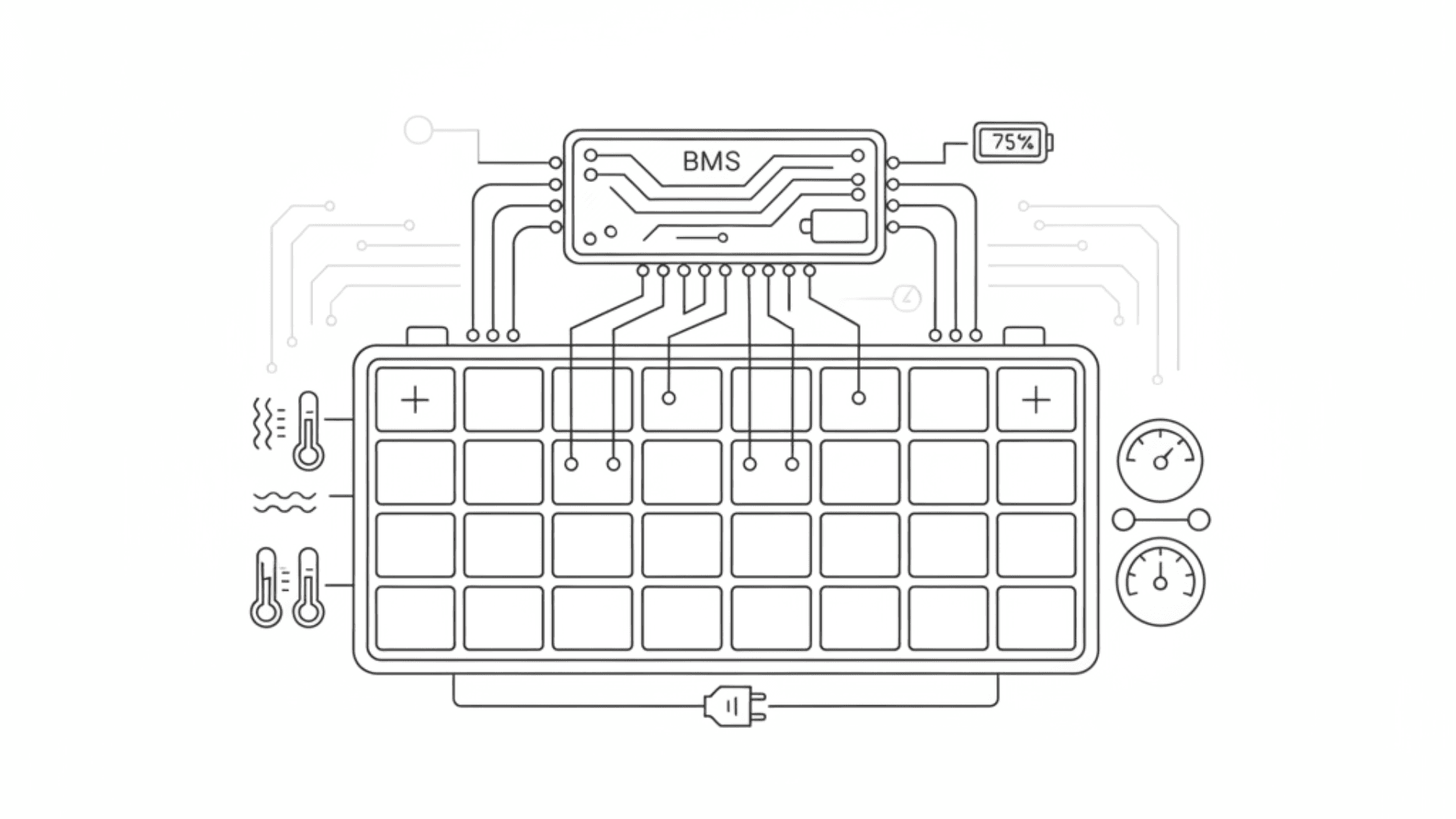
Have you ever wondered how the batteries of your electric vehicles, smartphones, etc., remain reliable. How they get maximum performance from their batteries without any exploding? The answer lies in a hidden, powerful technology known as the Battery Management System that works behind the scenes. This system is the brain of the battery pack. This system keeps your batteries safe, healthy, and efficient.
In this blog post, let’s discuss about battery management system and it’s role in the automotive world.
What is a Battery Management System (BMS)?
A Battery Management System is the brain behind the rechargeable batteries. It helps monitor, protect, and manage the functioning of cells together. It allows the batteries to deliver balanced and consistent power. It helps prevent batteries from overcharging, deep discharging, or overheating, extending their lifespan.
ABMS plays a very important role in the automotive machines. It simultaneously manages hundreds of individual cells. While simplified versions are used in smaller electronics. They enhance device safety and battery longevity by performing similar functions.
Why is a BMS Important?
One of the primary and foremost reasons to install a BS system is to ensure the safety of the battery. Lithium-ion batteries are so powerful that they can get damaged if not used properly. BMS is responsible for monitoring the operating conditions of the batteries. They take corrective measures to prevent batteries from overheating. A BMS not only prevents the hazardous failures of the batteries, but also the charging and discharging cycles. All these will help extend the overall lifespan of the battery.
BMS also balances the cell and provides accurate state-of-charge estimation. All these help prevent the sudden power loss. A BMS maintains the communication between cells and external systems. It is important as it optimizes the battery performance and prevents them from breaking down.
How Does a Battery Management System Work?
A BMS is like a smart guardian for the batteries. It constantly monitors and controls the working of the battery pack. It ensures that the batteries will work within the safe voltage and temperature limits. It optimizized the performance of the batteries by using two major components:
Components | Working |
Embedded sensors | Measures the variations (voltage, current, & temperature) |
Microcontrollers | Process & compare the data |
When the readings provided by embedded sensors go beyond the safe limits, the microcontrollers in the BMS automatically reduces the current, limits voltage discharge, or disconnects the batteries to correct the readings.
Some important functions performed by a BMS are:
Temperature control: Prevents thermal runaway of the batteries by maintain the temperature of the batteries.
Current monitoring: Monitors the current delivered by the batteries. This helps prevent overcharging or short circuit.
Voltage balancing: This helps balance equal charge across the cells in the batteries.
Health checks: Checks the working status of the batteries by estimating the charging state.
Key Components of a BMS
A battery management system is build using the following key components:
Battery monitoring sensors
As the name suggests, these are the sensors that monitors various parameters of the battery, such as voltage, current, or temperature.
Control unit
Just like a CPU, a BMS also has a control unit that acts as the brain. It is made up of microcontrollers that processes sensor data and makes critical real-time decisions.
Communication interface
This plays a major role in connecting BMS with the other systems of the batteries and ther external devices. transmits vital data about the battery, including health, performance, etc.
Protection circuits
Protection circuits add a safety layer to the system. The safety layer protects the batteries when the data values go beyond the safe limits. It does so by automatically disconnecting the battery.
Balancing circuits
As the name suggests, balancing circuits are responsible for maintaining equal charge across the cells. This ensures uniform performance and maximizes battery life
Types of Battery Management Systems
Let’s take a look at the three types of Battery Management Systems:
Centralized BMS
A centralized battery management system has a single control unit to manage the entire pack. This is ideal for small battery packs. While cost-effective and simple to design, it has a single point of failure.
Distributed BMS
A distributed BMS assigns monitoring modules to groups of cells. It communicates with a master controller. This type of BMS improves the scalability and reliability of the batteries. Therefore, this is suitable for large systems such as electric vehicles.
Modular BMS
A modular BMS system combines both centralized and distributed systems. In this hybrid system, modules perform local control and report to a central coordinator. It provides flexibility and scalability, and has higher implementation costs.
Comparison of Types of BMS
1. Centralized systems are best suited for small applications.
2. Distributed battery management systems excel in large-scale deployments.
3. Modular systems offer the most flexibility for complex requirements.
BMS in Different Applications
There are the following different applications of a BMS:
Electric vehicles (EVs)
The BMS is widely used in EVs to ensure maximum range and safety because it helps manage:
1. Charging
2. Regenerative braking
3. Thermal regulation
4. Power delivery
Renewable energy storage systems
BMS technology used in solar and wind installations helps regulate large stationary battery banks. These systems need a BMS system for maintaining effective flow of charge during charging and discharging cycles.
Consumer electronics
For maintaining the battery life of smartphones and laptops, compact integrated BMS chips are integrated into them. These chips extends the battery lifespan by managing safe charging and power usage.
Industrial power systems
Industrial power systems are being integrated with robust BMS configurations. They are important for backup and emergency power. This helps in predictive maintenance for incorporating remote monitoring.
Battery Balancing and Protection Mechanisms
As battery cells are used, chemical imbalances develop in them due to production differences and temperature variations. All these lead to the deterioration of the battery.
To address these issues, BMS employs two types of cell balancing, passive and active.
Passive balancing uses resistors to discharge cells with higher voltages. This helps dissipate excess energy as heat.
Active balancing transfers energy from higher to lower cells. This provides better efficiency.
Protection mechanisms safeguard systems from the following failure conditions:
1. Overvoltage
2. Undervoltage
3. Overcurrent
4. Short circuits
5. Extreme temperatures
Protection Mechanisms
The different types of protection systems work as below:
1. Voltage protection systems: Safeguard cell chemistry by protecting from over and under voltages.
2. Current protection systems: Control the overflow of current.
3. Thermal protection: Ensures that the batteries work within safe temperature limits.
Communication Protocols in BMS
There must be proper communication between BMS and other systems to avoid any issues. The CAN bus protocol is a primary choice for automotive systems.
SMBus or I2C protocols are used by smaller systems. These protocols need fewer connections and work well for short distances. Remote monitoring and diagnostics are being enabled with the emergence of wireless communication.
Standardized efforts, such as Battery Management System Interface (BMSi), unify communication protocols and data formats. This makes the system compatible across multiple devices.
Smart BMS and IoT Integration
The technology has advanced to create smart BMS systems that deliver monitoring and protection capabilities beyond basic functions. The new systems combine machine learning with Internet of Things (IoT) technology to achieve improved operational performance and maintenance prediction capabilities. The analysis of sensor data in the cloud enables pattern recognition, which leads to predictive maintenance and optimized charging strategies. The BMS units with IoT functionality establish communication with smart grids to schedule off-peak charging and deliver real-time battery information to users through mobile devices. Smart BMS systems combines over-the-air firmware updates with data analytics and app-based control systems.
Designing an Efficient BMS
The design of an efficient BMS system needs proper sensor choices, together with microcontroller capabilities and software algorithms and thermal systems, and safety compliance. Sensor accuracy directly affects how precisely the BMS can detect unsafe conditions or estimate charge levels. The selection of a microcontroller establishes both the processing power and energy usage of the system. Advanced software algorithms such as Kalman filters improve accuracy in estimating the state of charge and health. The battery and BMS hardware will stay within safe temperature bounds because of proper thermal management. The BMS system achieves safety and reliability standards through its compliance with ISO 26262 automotive standards and UL and IEC consumer device standards.
Future Trends in Battery Management Systems
The upcoming BMS technology will develop smart features that will provide adaptable solutions that protect the environment. Artificial intelligence will play a major role in predicting cell degradation and optimizing battery performance. The development of solid-state batteries will require BMS systems to adapt their designs because these batteries demonstrate different electrical characteristics and thermal properties. Wireless BMS systems will create simpler wiring systems, which will also reduce weight in electric vehicles. The system will allow electric vehicles to function as mobile power storage units, which can transfer electricity back to the grid during peak demand periods. The BMS system development will concentrate on sustainability because it exists as a fundamental objective for creating battery management systems that extend battery lifespans through second-life applications in stationary storage systems.
Conclusion
The Battery Management Systems started with basic protection circuits. Later, they are developed into advanced electronic systems that protect modern batteries. BMS also optimizes the performance and lifespan of the battery. With the increasing dependence of electric vehicles and renewable energy storage on batteries, BMS systems are gaining much attention.
You can combine AI advancements with IoT technology and new battery materials to create a more intelligent and smart system to create safer and longer-lasting batteries.
Frequently Asked Questions
1. Why is a BMS necessary for lithium-ion batteries?
BMS is important for Li-ion batteries to ensure their safe operation and prevent thermal runaway.
2. What type of BMS is best for electric vehicles?
Distribute or modular BMS architectures are generally used in electric vehicles.
3. How does a BMS increase battery lifespan?
A BMS increases the lifespan of batteries by temperature control, cell balancing, and maintaining charging and discharging cycles.
4. What is cell balancing in a BMS?
In a BMS, cell balancing means equalizing the voltages of all the cells in the battery.


