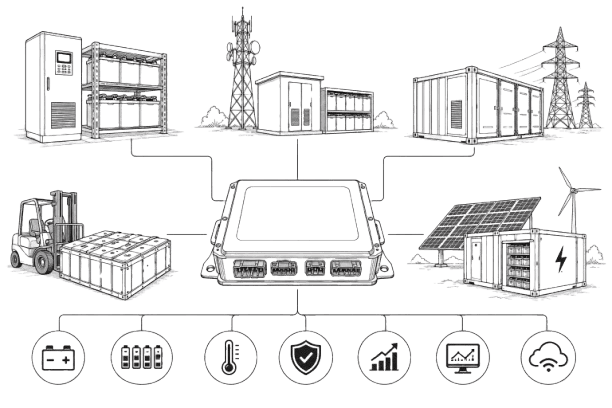
Lithium batteries are powering everything from UPS systems and telecom towers to renewable energy storage and large industrial battery packs. But behind every reliable lithium battery is a Battery Management System (BMS) working quietly in the background. A BMS continuously monitors the battery, protects it from potential faults, and ensures it delivers safe, efficient, and consistent performance throughout its lifespan. As energy storage becomes increasingly important across industries, having a smart and dependable BMS is no longer optional it's essential.
Without a properly designed BMS, even the highest-quality lithium cells can suffer from imbalance, overheating, reduced lifespan, and unexpected failures.
Today's energy infrastructure depends on intelligent battery management not only to protect batteries but also to maximize performance, improve operational reliability, and lower total cost of ownership.
At Xbattery, the BharatBMS-ESS platform has been engineered specifically for stationary energy storage applications, offering scalable battery management solutions for UPS systems, telecom infrastructure, renewable energy storage, and industrial battery packs.
Why every lithium battery system needs a BMS
A Battery Management System continuously monitors every critical parameter inside a battery pack.
Instead of treating the battery as a single unit, the BMS tracks each individual cell, ensuring they all operate within safe electrical and thermal limits.
A modern BMS performs several essential functions:
Individual cell voltage monitoring
Current measurement
Temperature monitoring
Cell balancing
State of Charge (SOC) estimation
State of Health (SOH) estimation
The result is a battery system that lasts longer, operates more safely, and delivers consistent performance throughout its lifecycle.
Why UPS Systems need an intelligent BMS
UPS systems are expected to deliver power instantly during outages.
Whether installed in hospitals, data centers, factories, or commercial buildings, UPS batteries remain on standby for extended periods before being called into action.
This creates unique battery management challenges.
A BMS ensures the battery remains healthy while waiting for backup events by:
Maintaining balanced cells
Preventing overcharging during float charging
Monitoring battery degradation
Detecting internal faults before failure
Monitoring battery temperature continuously
Reporting battery health for predictive maintenance
Without proper battery management, UPS batteries may lose usable capacity without obvious warning, reducing backup time exactly when it is needed most.
For lithium UPS systems, the BMS is effectively the intelligence layer that guarantees dependable emergency power.
Battery management for telecom infrastructure
Telecom towers cannot afford unexpected downtime.
Across remote installations, cellular base stations, and communication hubs, lithium batteries provide backup power whenever the electrical grid becomes unstable.
These locations often experience:
High ambient temperatures
Frequent power outages
Long maintenance intervals
Remote operation
An advanced BMS enables operators to remotely monitor battery performance while protecting batteries against harsh operating conditions.
Key telecom BMS capabilities include:
Remote diagnostics
Real-time battery monitoring
Fault notifications
Thermal protection
Accurate SOC reporting
Battery balancing
These features reduce maintenance costs while improving network uptime.
Battery Management Systems for Energy Storage Systems (ESS)
Battery Energy Storage Systems (BESS) are becoming a core part of modern electricity infrastructure.
They are used for:
Residential solar storage
Commercial energy storage
Industrial backup power
Peak shaving
Grid stabilization
Microgrids
Renewable energy integration
Unlike small battery packs, ESS installations contain hundreds or thousands of cells operating together.
Managing these safely requires a highly scalable Battery Management System.
The BMS performs several critical roles:
Continuous Cell Monitoring
Every cell is monitored individually to prevent voltage imbalance.
Intelligent Cell Balancing
Cell balancing ensures all cells charge and discharge evenly, improving battery lifespan and usable capacity.
Thermal Management
Temperature sensors detect abnormal heating before it becomes dangerous.
Real-Time Diagnostics
Operators receive continuous information about battery health and operating status.
Safety Protection
The BMS disconnects the battery during abnormal operating conditions including:
Overvoltage
Undervoltage
Overcurrent
Short circuit
Overtemperature
Together, these capabilities enable ESS deployments to operate safely over many years.
Managing industrial battery packs
Industrial battery packs are used across numerous applications:
Material handling equipment
Robotics
Backup power
Mobile machinery
Automated guided vehicles (AGVs)
Portable industrial systems
Each battery pack may have unique:
Voltage
Capacity
Cell chemistry
Cooling requirements
Communication interfaces
A flexible BMS platform allows manufacturers to build custom battery packs while maintaining a common monitoring architecture.
This simplifies development while improving safety and reliability across multiple product lines.
Renewable energy storage depends on advanced battery management
Renewable energy sources such as solar and wind are intermittent by nature.
Energy production often does not match energy demand.
Battery storage bridges this gap by storing excess electricity and releasing it when required.
However, renewable energy creates highly dynamic charging and discharging cycles.
The BMS continuously optimizes battery operation by:
Monitoring charging profiles
Protecting against excessive charging currents
Preventing deep discharge
Maintaining balanced cells
Monitoring battery temperature
Estimating remaining capacity
Communicating with inverters and energy management systems
The result is improved efficiency, longer battery life, and higher renewable energy utilization.
Essential features of a modern ESS battery management system
Today's battery systems require much more than basic voltage protection.
An enterprise-grade BMS should include:
Accurate Cell Voltage Measurement
Precise monitoring allows early detection of abnormal cell behavior before it affects the entire battery pack.
High-Precision Cell Balancing
Balanced cells improve usable capacity and extend battery lifespan.
Advanced Thermal Monitoring
Multiple temperature sensors help prevent overheating and thermal runaway.
State of Charge (SOC) Estimation
Accurate SOC algorithms improve system reliability by providing realistic battery capacity information.
State of Health (SOH) Monitoring
SOH estimation allows predictive maintenance and replacement planning.
Intelligent Fault Detection
The BMS rapidly identifies electrical abnormalities and isolates faults before they become hazardous.
Communication Interfaces
Modern systems require seamless integration with:
CAN FD
UART
SPI
Ethernet
These interfaces enable communication with inverters, PLCs, EMS platforms, and cloud monitoring systems.
BharatBMS-ESS from Xbattery
Xbattery's BharatBMS-ESS platform is designed specifically for stationary energy storage applications ranging from compact UPS installations to industrial-scale renewable energy systems.
Available configurations include:
Model | Typical Applications | Cell Support |
UPS, Telecom, Small ESS | Up to 16S | |
BharatBMS-ESS-72V | UPS, Battery Packs, Renewable Energy | Up to 28S |
BharatBMS-ESS-110V | Industrial ESS, Battery Packs | Up to 42S |
BharatBMS-ESS-800V | Large ESS, Grid-Scale Storage | Up to 250S |
The platform supports LFP, NMC, and Sodium-ion battery chemistries and includes:
High-accuracy cell monitoring
Passive cell balancing
Real-time diagnostics
Thermal protection
Fault management
SOC & SOH estimation
Open API support
Modular scalability
Remote monitoring
Industrial communication protocols
Its architecture enables deployments ranging from 5 kWh residential systems to megawatt-scale energy storage installations, making it suitable for diverse commercial and industrial use cases.
Choosing the right BMS for your application
Selecting a Battery Management System involves more than matching voltage ratings.
Consider:
Battery chemistry compatibility
Cell count scalability
Protection features
Communication interfaces
Thermal management capabilities
A well-designed BMS reduces maintenance costs, extends battery life, and improves the overall reliability of the energy storage system.
Conclusion
As lithium batteries continue to power UPS systems, telecom infrastructure, industrial battery packs, and renewable energy storage, the Battery Management System has become the foundation of safe and efficient operation.
An advanced BMS not only protects batteries from electrical and thermal faults but also delivers the intelligence needed to maximize performance, extend service life, and support remote monitoring across a wide range of applications.
With its modular architecture, advanced diagnostics, intelligent software, and support for both small-scale and grid-scale deployments, Xbattery's BharatBMS-ESS provides a scalable solution for organizations building the next generation of energy storage systems.
Frequently Asked Questions:
1. What is a Battery Management System (BMS)?
A Battery Management System (BMS) is an electronic system that monitors, protects, and manages lithium battery packs. It continuously tracks important parameters like voltage, current, temperature, and State of Charge (SOC) to ensure the battery operates safely, efficiently, and reliably.
2. Why is a BMS important for UPS, Telecom, and ESS applications?
A BMS protects batteries from overcharging, deep discharging, overheating, and short circuits while optimizing battery performance. In UPS, telecom, and Energy Storage Systems (ESS), it improves reliability, extends battery life, reduces maintenance costs, and ensures uninterrupted power during outages.
3. What applications does BharatBMS-ESS support?
BharatBMS-ESS is designed for a wide range of stationary energy storage applications, including:
UPS (Uninterruptible Power Supply)
Telecom backup power
Residential and commercial Energy Storage Systems (ESS)
Industrial battery packs
Solar energy storage
Wind energy storage
Microgrids
Renewable energy storage systems
4. Which battery chemistries are compatible with BharatBMS-ESS?
BharatBMS-ESS supports the most widely used lithium battery chemistries, including:
LFP (Lithium Iron Phosphate)
NMC (Nickel Manganese Cobalt)
Sodium-ion (Na-ion)
This makes it suitable for residential, commercial, and industrial energy storage applications.
5. How does cell balancing improve battery performance?
Cell balancing ensures that every cell in a battery pack maintains a similar voltage level. This prevents individual cells from becoming overcharged or over-discharged, improving battery efficiency, increasing usable capacity, and extending the overall lifespan of the battery pack.


