Introduction
Definition and concept
Digital twin is like a computer copy of a real thing. Just like how a photo shows what you look like, a digital twin shows how a battery works on a computer screen. It copies everything the real battery does ,how it charges, how it loses power, and how it behaves over time.
Importance of digital twins
See problems before they happen - Digital twins monitor battery health continuously and identify potential issues weeks or months before they cause failures or safety problems.
Save money - By fixing small problems before they become big, expensive ones, digital twins help avoid costly emergency repairs, reduce downtime, and prevent the need for complete system replacements that can cost thousands of dollars.
Make batteries last longer - Digital twins provide detailed insights into optimal charging patterns, usage conditions, and maintenance schedules, helping extend battery life by 20-40% compared to traditional management methods.
Keep everyone safe - Digital twins spot dangerous situations like overheating, overcharging, or electrical faults early, preventing potential fires, explosions, or other safety hazards that could harm people or damage property.
Learn and improve - Digital twins allow engineers to test new ideas, charging strategies, and optimization techniques in a virtual environment without risking damage to expensive real batteries or disrupting critical operations.
Application in Battery Management
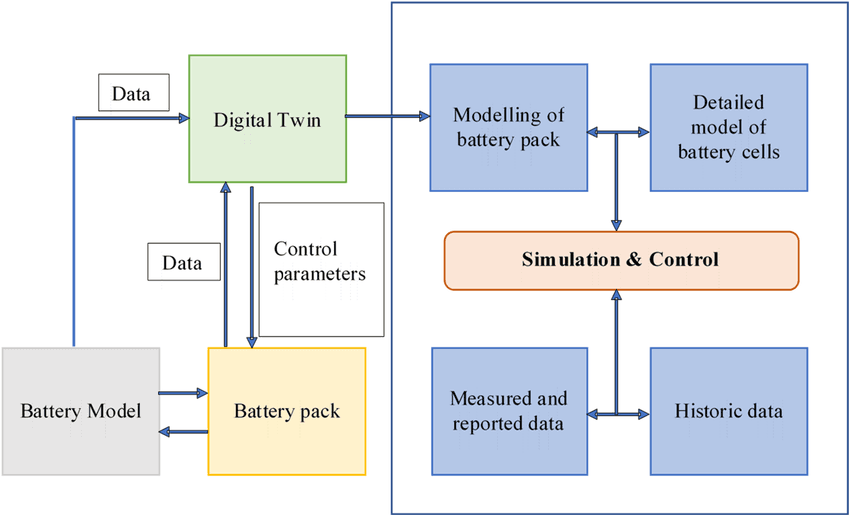
Source: Framework of a Digital Twin
Simulation and modeling
A battery digital twin is like a video game version of a real battery. Engineers can:
Test what happens if the battery gets too hot - Simulate extreme weather conditions, cooling system failures, or high-demand situations to understand how heat affects battery performance and identify safe operating limits.
See how long it will last under different conditions - Model various usage scenarios, from light everyday use to heavy industrial applications, to predict battery lifespan and plan replacement schedules accurately.
Try different ways to charge it - Experiment with fast charging, slow charging, partial charging cycles, and different charging schedules to find the optimal approach that balances speed with battery health.
Check how weather affects the battery - Analyze the impact of temperature changes, humidity levels, and seasonal variations on battery performance to optimize operations throughout the year.
This virtual battery simulation helps make better decisions without touching the real battery.
Monitoring and diagnostics
Smart battery monitoring means watching the battery all the time through sensors. These sensors tell the digital twin:
How much power is left - Real-time measurement of remaining battery capacity, charging state, and available energy to prevent unexpected shutdowns and optimize usage planning.
The battery's temperature - Continuous temperature monitoring across different battery sections to detect hot spots, cooling system performance, and thermal management effectiveness.
How fast it's charging or losing power - Tracking of charging and discharge rates to identify efficiency problems, unusual power draws, and optimal charging speeds for different conditions.
If anything looks wrong - Detection of abnormal voltage patterns, unusual current flows, irregular temperature spikes, or other warning signs that indicate developing problems or potential failures.
Predictive maintenance benefits
Instead of waiting for batteries to break, predictive battery analytics tells us when to fix them.
Stops unexpected breakdowns - By identifying potential problems weeks or months in advance, predictive analytics prevents sudden battery failures that could shut down critical operations or leave you stranded.
Saves money on repairs - Planned maintenance costs significantly less than emergency repairs, and fixing small issues early prevents them from causing expensive damage to other system components.
Keeps systems running smoothly - Scheduled maintenance during planned downtime ensures continuous operation without interruptions to business operations, production schedules, or daily activities.
Makes batteries last longer - Proper timing of maintenance, optimal charging practices, and early problem resolution can extend battery life by 30-50% beyond typical replacement schedules.
From Concept to Implementation
Steps for deployment
Building a battery digital twin follows these simple steps:
Choose the right batteries - Start with the most important ones
Add sensors - Install devices that measure temperature, voltage, and current
Collect data - Gather information about how the battery works
Build the computer model - Create the virtual copy
Test and improve - Make sure it works correctly
Train people - Teach staff how to use the new system
Scale up - Add more batteries to the system
Technology requirements
To create connected battery systems, you need:
Sensors - Small devices that measure things like temperature, voltage, current, and vibration, providing the eyes and ears for your digital twin system to understand what's happening with the real battery.
Internet connection - Reliable network connectivity to send sensor data to computers, receive control commands, and enable remote monitoring and management of battery systems from anywhere.
Computer software - Specialized programs that create the digital twin, analyze incoming data, run simulations, generate predictions, and provide user-friendly interfaces for monitoring and control.
Data storage - Secure and reliable places to keep all the collected information, historical records, and analysis results, ensuring data is available for long-term trend analysis and system improvements.
User interface - Easy-to-understand screens, dashboards, and mobile apps that show what's happening with your batteries, alert you to problems, and allow you to make informed decisions about battery management.
Integration challenges
Putting everything together can be tricky. Common problems include:
Old systems - Making new smart technology work with older equipment that wasn't designed for digital connectivity requires custom interfaces, adapters, and sometimes complete system upgrades that can be complex and expensive.
Different brands - Getting batteries, sensors, and software from different companies to work together smoothly often requires translation layers, custom programming, and careful coordination between various technical teams and vendors.
Too much data - Modern sensor systems can generate millions of data points daily, creating challenges in storage, processing, analysis, and identifying which information is actually useful for decision-making.
Staff training - Teaching people new skills to operate digital twin systems, interpret data, and make informed decisions based on predictive analytics requires time, resources, and ongoing education programs.
Cost - Managing the expense of new technology, including initial equipment purchase, installation, training, maintenance, and ongoing software subscriptions, while justifying the investment through measurable benefits.
Benefits for Industry
Efficiency improvements
Digital energy management makes everything work better:
Batteries charge faster when conditions are right - Smart systems automatically adjust charging speed, timing, and methods based on temperature, demand, and battery condition to achieve optimal charging without damaging the battery.
Power is used more wisely - Intelligent distribution systems ensure energy goes where it's needed most, reducing waste, balancing loads, and maximizing the efficiency of every stored kilowatt-hour.
Systems run smoother with fewer interruptions - Predictive maintenance and real-time monitoring prevent unexpected shutdowns, reduce downtime, and ensure continuous operation of critical systems.
Less energy is wasted - Optimized charging cycles, reduced standby power consumption, and better load management can decrease overall energy waste by 15-25% compared to traditional battery management methods.
Cost savings
Advanced battery diagnostics save money by:
Reducing repair costs - Early problem detection allows for minor fixes instead of major overhauls, often reducing repair expenses by 40-60% compared to waiting for complete system failures.
Making batteries last longer - Optimal management practices, proper charging protocols, and timely maintenance can extend battery lifespan by 2-3 years beyond normal replacement schedules.
Preventing expensive breakdowns - Avoiding catastrophic failures that could damage other equipment, cause production shutdowns, or require emergency repairs that cost 3-5 times more than planned maintenance.
Using energy more efficiently - Smart management reduces electricity costs through optimized charging during off-peak hours, reduced energy waste, and better integration with renewable energy sources.
Planning better for the future - Accurate lifespan predictions and performance forecasting help companies budget for replacements, avoid rush purchases, and negotiate better deals with suppliers.
Sustainability impact
Digital twins help the environment by:
Making batteries last longer (less waste) - Extended battery life means fewer batteries need to be manufactured and disposed of, reducing mining for raw materials and decreasing hazardous waste in landfills.
Using energy more efficiently - Smart management systems reduce overall energy consumption by 10-20%, decreasing demand on power grids and reducing carbon emissions from electricity generation.
Reducing the need for new batteries - Better maintenance and optimization can delay replacement cycles, reducing the environmental impact of battery manufacturing, transportation, and packaging.
Helping renewable energy work better - Improved battery storage systems make solar and wind power more reliable and practical, supporting the transition away from fossil fuel-based energy sources.
Lowering carbon emissions - More efficient energy use, reduced manufacturing needs, and better support for renewable energy collectively contribute to significant reductions in greenhouse gas emissions.
Future Outlook
AI and IoT integration
The future of battery lifecycle optimization includes:
Artificial Intelligence (AI) - Computers that learn and make smart decisions
Internet of Things (IoT) - Everything connected and talking to each other
Machine learning - Systems that get smarter over time
Automated responses - Fixing problems without human help
Scalability across sectors
Digital twins for batteries will grow in many areas:
Electric cars - Better range and faster charging
Smart homes - More reliable backup power
Renewable energy - Better storage for solar and wind power
Hospitals - Safer emergency power systems
Data centers - More reliable computer operations
Conclusion
Digital twins are changing how we manage batteries. They make battery systems smarter, safer, and more efficient. As technology gets better and cheaper, more companies will use digital twins to improve their battery management.
The journey from concept to implementation takes time and planning, but the benefits are worth it. Companies that start now will have better battery systems and save money in the long run.
Digital twins represent the future of energy storage systems. They help us build a world where batteries work better, last longer, and support our growing need for clean, reliable energy.
Frequently Asked Questions
1. What industries use digital twins for batteries?
Key industries include automotive (electric cars), energy companies (power storage), healthcare (hospital backup systems), manufacturing (factory equipment), and telecommunications (cell tower backup power).
2. How do digital twins improve battery safety?
Digital twins improve safety by providing early warnings for dangerous conditions, monitoring temperature to prevent fires, tracking voltage problems, detecting unsafe batteries, and automatically shutting down dangerous systems.
3. Can digital twins predict battery failures?
Yes, digital twins can predict failures by learning normal battery behavior patterns, using historical data from similar batteries, monitoring systems 24/7, and tracking performance trends over time.
4. Are digital twins only for large-scale systems?
No, digital twins work for all battery sizes - from large power grids and electric car fleets to medium office buildings, small home systems, and even smartphones. The cost and complexity vary by size.


