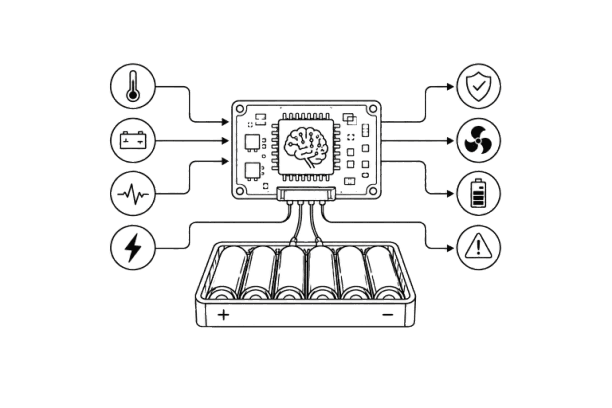
Battery Management Systems (BMS) have always been the quiet decision-makers inside every EV, energy storage unit, and battery-powered device. They monitor voltage, temperature, and current, and they decide when to charge, when to throttle, and when to shut down to prevent failure. Traditionally, the heavier analytical work predicting battery health, forecasting degradation, detecting subtle fault patterns has been offloaded to the cloud.
That is changing. Edge AI is moving these intelligent models directly onto the BMS hardware itself, right next to the cells they are protecting. Here is why that shift matters, and what it actually involves.
What "Edge AI in BMS" Actually Means
In a conventional setup, a BMS collects sensor data, sends it to a cloud server or a remote data center, waits for that server to run a model and return a decision, and then acts on it. This works fine for long-term analytics but it introduces delay, and it depends entirely on network connectivity.
Edge AI flips this. Instead of shipping raw data elsewhere, a compact AI model is deployed directly onto the microcontroller or embedded processor inside the BMS. The model runs locally, using the hardware that is already sitting on the battery pack, and makes decisions in real time no round trip to the cloud required.
Why Move Intelligence to the Edge?
1. Real-Time Decision-Making
Battery faults thermal runaway precursors, cell imbalance, sudden internal resistance spikes can develop in milliseconds. A cloud round trip, even a fast one, introduces latency that a fast-developing fault simply will not wait for. An on-device model can detect and respond within the same control loop cycle, cutting off a charging path or triggering a cooling response before the situation escalates.
2. Independence from Connectivity
Vehicles pass through tunnels, remote areas, and signal dead zones. Industrial battery installations are sometimes deployed in locations with unreliable networks. A cloud-dependent BMS is only as reliable as its weakest connection. Edge AI keeps critical safety decisions functioning even with zero connectivity.
3. Reduced Data Transmission Costs
Streaming continuous high-frequency sensor data (voltage, current, temperature, impedance) to the cloud for every cell, every millisecond, across a large EV fleet or battery farm, is expensive and bandwidth-heavy. Running inference locally means only summarized insights or flagged anomalies need to be transmitted, not raw data streams.
4. Improved Privacy and Security
Keeping sensitive operational data usage patterns, degradation curves, proprietary battery chemistry signatures on-device reduces exposure to interception or breaches during transmission, which matters more as batteries become networked assets.
5. Lower Power Overhead
Ironically, constantly transmitting data over cellular or Wi-Fi radios consumes meaningful energy a real concern in a system whose entire purpose is preserving energy. Lightweight on-device inference typically draws far less power than sustained wireless transmission.
What Kinds of AI Models Run on BMS Hardware?
Edge AI in BMS does not mean running large, complex neural networks the hardware constraints do not allow for that. Instead, engineers rely on models specifically compressed and optimized for embedded environments:
State of Charge (SoC) and State of Health (SoH) estimators
Lightweight regression or small neural network models that predict remaining capacity and degradation more accurately than traditional lookup-table methods
Anomaly detection models
Compact classifiers trained to recognize early signatures of thermal runaway, internal short circuits, or cell imbalance
Predictive maintenance models
Small time-series models that forecast when a cell or module is likely to degrade beyond safe operating parameters
Adaptive charging algorithms
Reinforcement-learning-based or rule-refined models that adjust charge rates dynamically based on real-time cell behavior, rather than following a fixed static profile
These are typically built using techniques like model quantization, pruning, and knowledge distillation — compressing a larger trained model down into something that can run within kilobytes of memory on a microcontroller.
The Hardware Side: What Makes This Possible
Running AI directly on a BMS requires purpose-built or adapted hardware:
Microcontrollers with embedded NPUs (Neural Processing Units)
Increasingly common in newer automotive-grade chips designed specifically for on-device inference
Low-power ARM Cortex-M series processors
Widely used for constrained edge inference tasks
Dedicated AI accelerators
Some newer BMS reference designs integrate small dedicated silicon blocks purely for running compressed neural network inference alongside standard battery monitoring circuitry
The tight constraint here is that BMS hardware must remain cheap, low-power, and reliable over the multi-year life of a battery pack so these models have to run efficiently within very limited compute and memory budgets.
Real-World Impact
Electric vehicles
Real-time SoH estimation and thermal anomaly detection directly on the vehicle's BMS improves safety response time and gives drivers more accurate range predictions without depending on connectivity.
Grid-scale energy storage
Large battery farms use edge inference at the module level to catch early degradation signs, reducing costly downtime and extending asset life without needing to stream every data point to a central server.
Consumer electronics and portable batteries
Edge-based charge optimization models extend battery lifespan by adapting charging behavior to how a specific device is actually used, rather than relying on generic charge curves.
Challenges Still Being Solved
Compute and memory limitations
Squeezing meaningful predictive accuracy into a few kilobytes of RAM is still an active area of engineering work
Model updates in the field
Unlike cloud models that can be updated instantly, edge models require secure over-the-air update mechanisms to improve or patch behavior post-deployment
Validation and certification
Safety-critical systems like BMS face rigorous certification standards, and proving an AI model's reliability across edge cases is more complex than validating traditional rule-based logic
Balancing accuracy vs. efficiency
Smaller, faster models are necessary for real-time response, but they need to retain enough predictive accuracy to be trustworthy for safety-critical decisions
Looking Ahead
As battery packs get larger, chemistries get more complex (moving beyond standard lithium-ion into solid-state and other next-generation cells), and demand for faster, safer, more autonomous energy systems grows, pushing intelligence to the edge is becoming less of an optimization and more of a necessity. The BMS of the future will not just report data upstream it will think, decide, and protect the battery in real time, independent of the cloud.
Edge AI does not replace the cloud entirely long-term fleet analytics, large-scale model training, and historical trend analysis still benefit from centralized processing. But for the decisions that matter in milliseconds, the intelligence needs to live where the battery lives: right at the edge.
Frequently Asked Questions:
1. What is Edge AI in a Battery Management System? Edge AI refers to running AI models directly on the BMS hardware, right next to the battery cells, instead of sending data to the cloud for processing. The device makes decisions locally, in real time.
2. Why cannot a cloud-based BMS handle real-time decisions well enough? A cloud round trip introduces latency, since data has to travel to a server, get processed, and return with a decision. Battery faults such as thermal runaway precursors can develop in milliseconds, which is faster than most cloud communication cycles can respond to.
3. Does Edge AI mean the BMS no longer needs an internet connection? For critical safety decisions, yes. The on-device model can detect issues and act independently of network connectivity. However, connectivity is still useful for long-term analytics, fleet-wide monitoring, and software updates.
4. What kinds of AI models can actually run on BMS hardware? Only lightweight, compressed models are practical, such as State of Charge and State of Health estimators, anomaly detection classifiers, predictive maintenance models, and adaptive charging algorithms. These are built using techniques like quantization, pruning, and knowledge distillation to fit within a microcontroller's limited memory.
5. What hardware is needed to run AI models on a BMS? Common options include microcontrollers with embedded Neural Processing Units, low-power ARM Cortex-M series processors, and dedicated AI accelerator chips built specifically for embedded inference.


