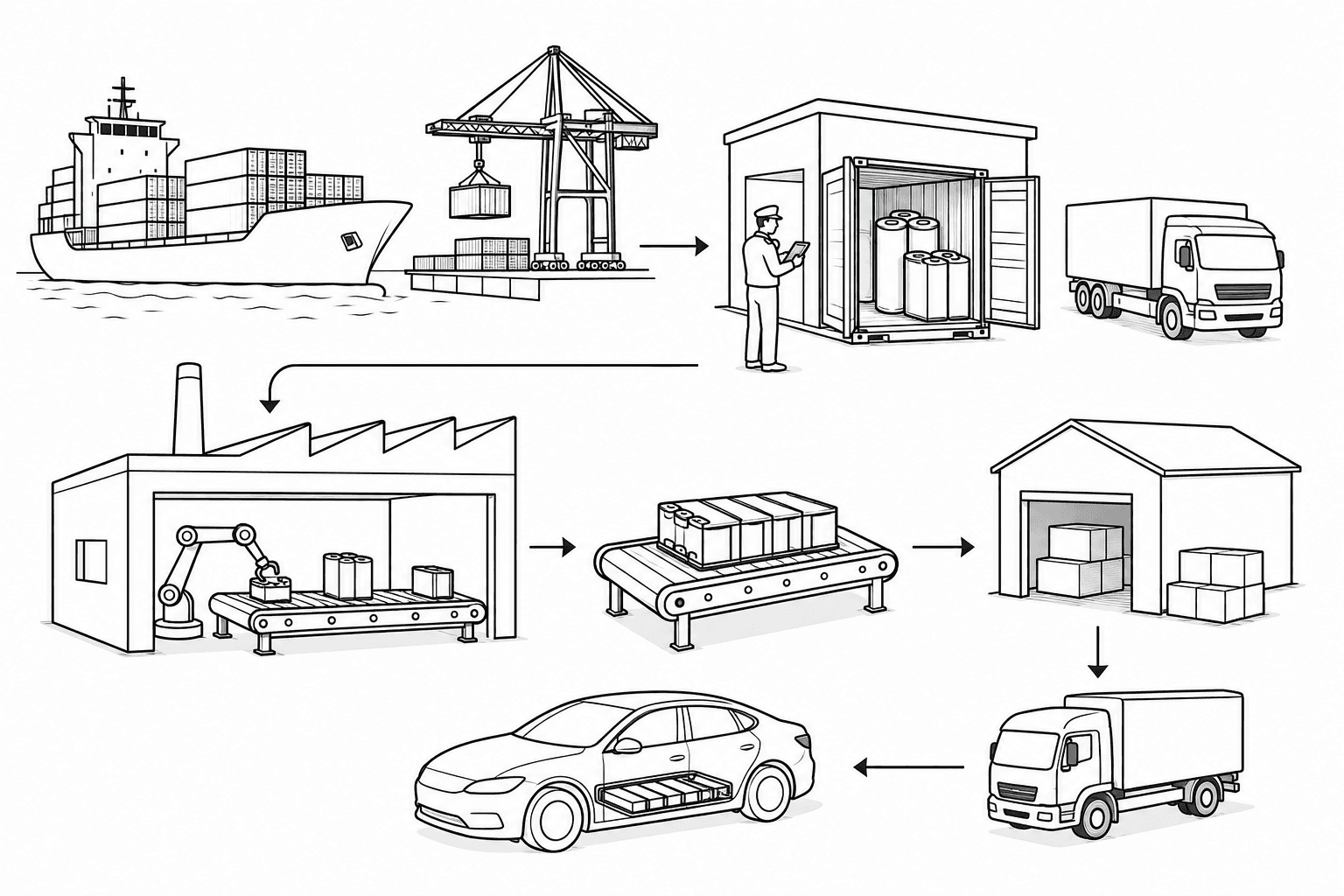
Renewables and electric mobility are all the craze nowadays, and at the heart of both sits one component: the lithium-ion cell. Whether it's an EV battery pack or a grid-scale storage system, India still imports the majority of its cells, which makes customs and import duty policy one of the most consequential levers the government has to shape the domestic battery industry. Let's look at what it is -
Duty on every cell that crosses the border
Basically, import duty and customs policy on lithium-ion cells is exactly what it sounds like: the taxes and exemptions applied when battery cells, battery components, and the raw materials or machinery used to make them enter India. Since almost every EV, energy storage system, and even mobile phone in the country relies on lithium-ion cells, and since domestic manufacturing is still catching up, these duty rules directly affect what battery-powered products cost on the shelf.
Import duty on batteries in India is not a single number. It is layered, combining a Basic Customs Duty (BCD), an Integrated Goods and Services Tax (IGST), a Social Welfare Surcharge (SWS), and in some cases an Anti-Dumping Duty (ADD) aimed at specific countries. On top of this base structure, the government has carved out a growing set of exemptions specifically to encourage cell manufacturing to happen inside India rather than abroad.
To understand how this works, let's break the policy into two parts: the standard duty structure that applies to finished batteries, and the exemptions that apply to manufacturing inputs.
Standard duty structure on finished batteries
When a finished lithium-ion battery or battery pack is imported into India, it generally attracts a Basic Customs Duty that typically ranges between 10% and 20% depending on the specific tariff classification. On top of this, an IGST of around 18% is applied to the sum of the assessable value and the basic duty, effectively taxing the duty itself. A Social Welfare Surcharge, usually 10% of the BCD amount, is added on top, and is meant to fund social welfare projects rather than protect domestic industry.
For batteries coming from certain countries, particularly China, additional Anti-Dumping Duties may apply. These are designed to prevent foreign manufacturers from selling cells in India at prices below their production cost, which would otherwise undercut Indian manufacturers before they can scale up.
This layered structure means a finished, imported battery can end up considerably more expensive than the same cell brought in as a raw input for domestic assembly, which is exactly the incentive the government is trying to create.
Exemptions for manufacturing inputs
Have you ever wondered why India keeps announcing duty cuts on things like lithium carbonate or cell-making machinery instead of just taxing finished batteries less? That's the second, and arguably more important, half of this policy.
Rather than only taxing finished imports, India has steadily built out a system of exemptions on the raw materials, chemicals, and capital equipment needed to manufacture lithium-ion cells domestically. The logic is straightforward: if a company is willing to build a cell factory in India, the government wants to remove as much cost friction as possible from that investment, even while imported finished batteries remain fully taxed.
Key raw materials for battery-grade chemistry, including lithium oxide, lithium hydroxide, and lithium carbonate, now enter India duty-free, down from a basic customs duty of 7.5% previously. Import duties have also been exempted on other critical minerals used in battery and clean-energy manufacturing, such as cobalt powder, lithium-ion battery waste (for recycling), lead, zinc, and a dozen other listed minerals, aimed at securing a stable domestic raw material supply.
On the capital goods side, the exemption on machinery used to manufacture lithium-ion cells for EV batteries has existed since the 2023-24 Budget. This has since been extended to cover capital goods used specifically for manufacturing lithium-ion cells for Battery Energy Storage Systems (BESS) as well, recognizing that grid-scale storage now needs the same manufacturing support that EV batteries received earlier. The list of exempted capital goods has also been expanded, with 35 additional items added for EV battery production and 28 for mobile phone battery manufacturing.
How this policy fits into the bigger picture
Now, let's take a look at how customs policy connects with the other pieces of India's battery ecosystem.
1. Complementing the PLI Scheme: The Production Linked Incentive scheme for Advanced Chemistry Cells rewards manufacturers for producing cells domestically. Customs exemptions on machinery and raw materials lower the upfront capital cost of setting up that same manufacturing, making the two schemes work in tandem rather than in isolation.
2. Supporting BESS Deployment: As Viability Gap Funding pushes battery energy storage projects to scale up, extending capital goods exemptions to BESS-specific cell manufacturing ensures that the storage boom doesn't end up being built almost entirely on imported cells.
3. Protecting Nascent Domestic Manufacturing: Anti-dumping duties on finished batteries from specific countries act as a buffer, giving Indian cell manufacturers time to reach viable production scale without being undercut by underpriced imports.
4. Reducing Landed-Cost Gaps: Industry estimates suggest these combined measures are gradually narrowing the cost difference between imported and domestically made cells, which had been as high as 22% in 2023, with a goal of shrinking that gap significantly over the next few years.
Challenges of import duty & customs policy on lithium-ion cells
1. Compliance Complexity: Businesses importing batteries must navigate BIS registration for lithium-ion cells, EPR authorization from the Central Pollution Control Board, labeling requirements under Legal Metrology Rules, and safety testing at accredited labs, all layered on top of the duty structure itself.
2. Domestic Manufacturing Still Nascent: Even with capital goods exemptions in place, actual cell-level manufacturing in India remains limited, meaning most "domestic" battery packs are still largely assembled from imported cells rather than built from domestically produced ones.
3. Frequent Policy Changes: Customs notifications and exemption lists are revised nearly every budget cycle, which means manufacturers and importers must continuously track updates to know which specific inputs currently qualify for relief.
4. Balancing Consumer Cost with Industrial Policy: Duties on finished batteries, while protecting domestic industry, can raise costs for consumer electronics and EVs in the near term, creating a trade-off between long-term self-reliance and short-term affordability.
5. Import Dependence on Raw Materials: Even as duties on lithium salts are removed to help manufacturers, India still depends almost entirely on imports for the lithium and cobalt themselves, since domestic mineral processing capacity is still being built out.
Import Duty & customs policy in India: Recent Developments
India's battery import duty framework has evolved considerably over the past few Union Budgets, moving from a narrow EV-only focus to a broader clean-energy manufacturing strategy.
The Union Budget 2026-27 extended the existing basic customs duty exemption on capital goods used for manufacturing lithium-ion cells for batteries to also cover capital goods used for lithium-ion cells destined for Battery Energy Storage Systems. This was widely seen by industry as recognition that grid-scale storage manufacturing deserves the same policy support that EV battery manufacturing has had since 2023.
Alongside this, the Budget removed duties on a range of critical minerals and inputs, including lithium oxide, hydroxide, and carbonates, along with cobalt powder, lithium-ion battery waste, lead, zinc, and other minerals used in battery and clean-energy supply chains. The government also added 35 capital goods to the exemption list for EV battery manufacturing and 28 for mobile phone battery manufacturing, broadening the scope of what qualifies for relief.
These moves sit alongside the Production Linked Incentive scheme for Advanced Chemistry Cells, budgeted at roughly ₹18,100 crore, and the Viability Gap Funding scheme for battery energy storage, together forming a three-pronged approach: subsidize the capital investment (PLI), subsidize the project economics (VGF), and reduce the cost of building and importing the underlying manufacturing capacity (customs duty exemptions). Industry voices have welcomed the direction, though several have also flagged concerns such as inverted GST structures, where inputs are taxed at a higher rate than the finished battery products they go into, creating cost pressure for manufacturers even as import duties fall.
Frequently Asked Questions:
1. What duties apply to imported lithium-ion batteries in India?
Finished batteries generally attract Basic Customs Duty of around 10% to 20%, an IGST of about 18%, a Social Welfare Surcharge of 10% of the BCD, and in some cases country-specific anti-dumping duties.
2. Why does India exempt duty on lithium-ion manufacturing inputs but tax finished batteries?
The exemptions on raw materials and capital goods are designed to make it cheaper to manufacture cells inside India, while duties on finished imports encourage that manufacturing to actually happen domestically rather than abroad.
3. What changed for battery manufacturing in the Union Budget 2026-27?
The BCD exemption on capital goods for lithium-ion cell manufacturing was extended to cover cells for Battery Energy Storage Systems, and duty was removed on key raw materials like lithium oxide, hydroxide, carbonates, cobalt powder, and other critical minerals.
4. How does customs policy relate to the PLI scheme and VGF scheme?
Customs duty exemptions lower the capital cost of building cell manufacturing capacity, the PLI scheme rewards actual cell production, and VGF supports the economics of storage projects that ultimately use those cells, together forming a coordinated policy push.
5. What compliance is required to import lithium-ion batteries into India?
Importers typically need BIS registration for lithium-ion cells, EPR authorization from the CPCB, WPC clearance for wireless features where applicable, correct labeling under Legal Metrology Rules, and safety testing at accredited laboratories.


