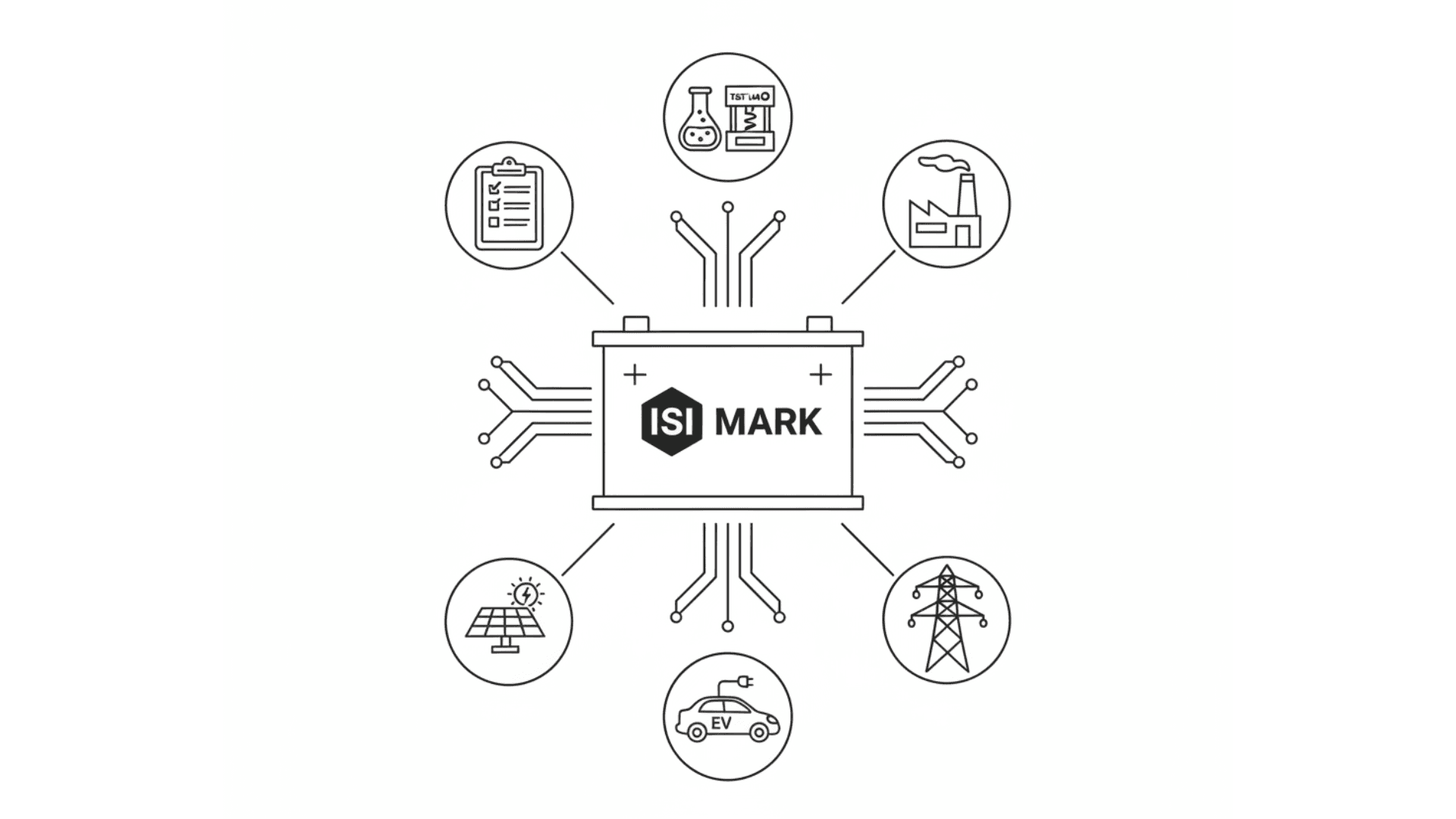
In India's rapidly growing battery market, ensuring safety and quality is not just good practice, it is mandatory. The Bureau of Indian Standards (BIS) sets the benchmark for battery systems, protecting consumers and maintaining industry standards. Whether you are manufacturing lithium-ion batteries for electric vehicles, energy storage systems, or portable electronics, understanding BIS compliance is essential for your business success.
Why BIS Standards Matter for Battery System Safety and Quality
Battery systems, especially lithium-ion batteries, pose significant safety risks if not manufactured to proper standards. Thermal runaway, fire hazards, and chemical leaks are real concerns that BIS standards address through rigorous testing and quality protocols. For manufacturers, BIS certification is not just a regulatory checkbox, it is a commitment to customer safety and product reliability.
The Indian government has made BIS certification mandatory for various battery types to prevent substandard products from entering the market. This regulatory framework protects both consumers and legitimate manufacturers who invest in quality production.
When a battery system fails, the consequences can be devastating. We have seen news reports of phone batteries exploding, electric scooters catching fire, and energy storage systems malfunctioning. These incidents erode consumer confidence and damage the entire industry's reputation. BIS standards exist to prevent such tragedies by ensuring every certified battery meets stringent safety criteria.
What Manufacturers Need to Know About Compliance
BIS compliance involves multiple stages, from understanding applicable standards to obtaining final certification. Manufacturers must navigate documentation requirements, laboratory testing, factory inspections, and ongoing quality maintenance. The process can seem overwhelming, especially for new entrants, but with proper preparation and understanding, it becomes manageable.
Think of BIS compliance as building a house. You need a strong foundation (quality systems), proper materials (documentation), skilled workers (trained staff), and regular inspections (ongoing compliance). Skip any step, and the entire structure becomes unstable.
This guide walks you through everything you need to know about BIS compliance for battery systems, providing a clear roadmap to certification success.
BIS Standards Explained
Essential BIS Standards Applicable to Battery Systems
Several BIS standards govern different aspects of battery systems in India. Understanding which standards apply to your product is crucial because testing requirements, documentation, and certification processes vary accordingly.
IS 16046 (Part 1 & 2): 2018 covers lithium-ion cells and batteries used in portable applications. This standard specifies safety requirements and test methods to ensure batteries can withstand various stress conditions without posing hazards. If you manufacture batteries for mobile phones, laptops, power banks, or similar portable devices, this is your primary standard.
IS 16893: 2018 focuses on lithium-ion traction battery packs and systems for electric vehicles. This standard addresses the unique requirements of EV batteries, including thermal management, mechanical integrity, and electrical safety. The testing under this standard is more rigorous because EV batteries operate under harsher conditions, higher power demands, and greater safety risks.
IS 17424: 2020 covers stationary battery energy storage systems. As India expands its renewable energy capacity, this standard ensures grid-connected and off-grid battery storage systems meet safety and performance benchmarks. These systems must handle frequent charge-discharge cycles, weather variations, and integration with solar or wind power setups.
AIS 048 & AIS 156 are Automotive Industry Standards that work alongside BIS standards for vehicle battery systems. These cover installation, mounting, vehicle integration, and system-level safety aspects that go beyond the battery pack itself.
Each standard defines specific testing protocols, performance criteria, and safety margins that manufacturers must meet. The standards are technical documents, often running hundreds of pages, but they provide the exact specifications your product must achieve.
Which Battery Technologies Require Certification
BIS certification requirements vary based on battery chemistry and application. The government updates this list periodically as new technologies emerge and market needs evolve.
Mandatory Certification applies to:
Lithium-ion batteries and cells for portable applications like smartphones, tablets, and laptops.
Lithium-ion battery packs for electric vehicles including two-wheelers, three-wheelers, and four-wheelers.
Battery management systems (BMS) integrated with battery packs, as these control safety functions.
Lithium-ion batteries for energy storage systems connected to solar installations or the grid.
Currently Under Review or Voluntary:
Lead-acid batteries, though some categories may become mandatory.
Nickel-metal hydride batteries used in certain hybrid vehicles.
Battery chargers and charging infrastructure, which have separate certification pathways.
The government regularly updates the mandatory certification list through official notifications. Manufacturers should regularly check BIS announcements to stay informed about changes affecting their products. What is voluntary today might become mandatory tomorrow, so planning ahead prevents last-minute scrambles.
Meeting Compliance Requirements
Required Documentation and Paperwork
Successful BIS certification starts with proper documentation. Think of documentation as telling your product's story, from raw materials to finished battery. BIS needs to understand exactly what you make, how you make it, and how you ensure quality.
Company Documents establish your legitimacy and authorization:
Business registration certificates proving your company legally exists.
Factory license and manufacturing authorization from local authorities.
ISO 9001 or equivalent quality management system certification, which is preferred but not always mandatory.
Power of attorney for Indian representative, required for foreign manufacturers operating outside India.
Technical Documents explain your product in detail:
Detailed product specifications and datasheets covering every electrical, mechanical, and chemical parameter.
Manufacturing process flow diagrams showing each production step from raw material to finished product.
Quality control procedures and inspection plans describing how you verify quality at each stage.
Bill of materials (BOM) listing every component with specifications, supplier details, and part numbers.
Circuit diagrams and technical drawings providing visual understanding of your battery design.
Battery management system (BMS) documentation including firmware versions, protection algorithms, and communication protocols.
Testing Documents prove your product meets standards:
Test reports from BIS-recognized laboratories showing your battery passed all required tests.
Component certificates from suppliers, especially for critical parts like battery cells.
Previous certification records if you have certifications from other countries or for similar products.
Risk assessment and safety analysis reports identifying potential hazards and mitigation measures.
Foreign manufacturers face additional requirements. You must appoint an authorized Indian representative who becomes responsible for all compliance matters. This person handles correspondence with BIS, coordinates factory inspections, and manages market surveillance issues. Choose this representative carefully, as they become the face of your company for regulatory purposes.
The Testing and Certification Journey
The BIS certification process follows a structured path that typically takes several months. Understanding each stage helps you prepare properly and avoid delays.
Step 1: Application Submission
You begin by submitting your application through the BIS online portal. The portal is reasonably user-friendly, though first-time users may need some time to navigate it. Along with the application, you submit all required documents and pay application fees.
BIS reviews your application for completeness. If anything is missing or unclear, they communicate deficiencies that you must correct. This initial review typically takes 2-3 weeks. Many applications get delayed at this stage due to incomplete documentation, so triple-check everything before submitting.
Step 2: Product Testing
Your battery samples go to BIS-approved testing laboratories. You typically need to provide multiple samples, usually 10-20 pieces depending on the standard and tests required. The laboratory conducts extensive testing that simulates years of use and various abuse conditions.
Tests include electrical performance evaluations like capacity measurement, voltage stability, and internal resistance. Safety tests push your battery to extremes through overcharge, short circuit, and thermal abuse scenarios. Environmental tests subject batteries to temperature cycling, vibration, and shock to ensure they work reliably in real-world conditions. Mechanical tests like crush, nail penetration, and drop tests verify structural integrity.
Testing typically takes 6-12 weeks depending on product complexity and laboratory workload. Some tests run for days or weeks, especially endurance and cycling tests. Failed tests require understanding the failure mode, potentially redesigning your product, manufacturing new samples, and retesting, which adds months to the timeline.
Step 3: Factory Inspection
BIS conducts an initial factory inspection to verify you have the capability to consistently manufacture products that match your tested samples. This is not just a paperwork exercise. Inspectors physically visit your factory and examine everything.
They assess production equipment and its calibration status. They review your raw material verification procedures to ensure you are using quality inputs. They examine in-process and final inspection protocols to verify you catch defects. They check testing equipment and maintenance records. They scrutinize documentation and record-keeping systems to ensure proper traceability.
Factory inspections can be nerve-wracking, but remember that inspectors want to see genuine quality systems, not perfection. They understand manufacturing realities and focus on whether you have processes to maintain quality consistently.
Step 4: Certification Grant
Upon successful testing and factory inspection, BIS grants certification and issues a license to use the BIS standard mark, commonly known as the ISI mark. This license is initially valid for one year and can be renewed annually. You receive a license number that must appear alongside the ISI mark on your products.
Getting that certification letter is a significant achievement. It represents months of effort and investment, and it opens the Indian market to your products.
Step 5: Ongoing Surveillance
BIS compliance does not end with certification. BIS conducts periodic surveillance visits to ensure you maintain quality standards. They may visit your factory unannounced or sample your products from the market for retesting.
You must maintain detailed production records, quality control data, and traceability information. Any significant changes to your product, manufacturing process, or suppliers must be reported to BIS and may require re-evaluation.
Your Compliance Roadmap
Getting Ready Before You Apply
Preparation significantly impacts your certification timeline and success rate. Many manufacturers rush into the application process without adequate preparation, leading to failed tests, inspection issues, and costly delays.
Conduct a Gap Analysis
Before applying, honestly compare your current manufacturing practices against BIS standard requirements. Read the relevant standards thoroughly, not just summaries. Identify areas needing improvement in equipment, processes, or documentation. This gap analysis might reveal you need better testing equipment, improved process controls, or enhanced documentation systems.
Upgrade Testing Facilities
While final certification testing happens at BIS-approved laboratories, you need basic testing equipment for in-house quality checks. Equipment like multimeters, capacity testers, and temperature sensors help you verify product quality before shipping samples for official testing. Internal testing capabilities also demonstrate quality commitment during factory inspections and help catch issues early before they become expensive failures during certification testing.
Train Your Team
Your success depends heavily on your team's understanding. Ensure technical staff understands BIS standards, testing procedures, and documentation requirements. Production workers need training on quality procedures and why they matter. Quality control personnel must know inspection criteria and recording methods.
Consider hiring or consulting with experts experienced in BIS certification. Their experience can save you months of trial and error. Many consultants offer services ranging from gap analysis to complete certification management.
Select the Right Testing Laboratory
Choose a BIS-recognized laboratory with proven experience in your specific battery type. Not all approved laboratories have equal expertise. Some specialize in portable batteries, others in EV batteries or energy storage systems. Contact laboratories before applying to understand their processes, timelines, and any preliminary testing they recommend.
Establish good communication with your chosen laboratory. They can advise on sample preparation, common failure points, and testing schedules. A good relationship with the lab can smooth the testing process considerably.
Prepare Sample Products
Manufacture samples that accurately represent your final production quality. Do not send your absolute best handmade prototypes that production cannot replicate. Inconsistencies between test samples and production units create serious problems later during surveillance testing or market sampling.
Ensure samples are properly labeled, packaged, and documented. Include serial numbers, manufacturing dates, and any other traceability information that links samples to production batches.
Implementing Quality Assurance Practices
BIS compliance requires robust quality management systems that operate consistently, not just during certification but throughout your manufacturing life.
Incoming Material Inspection
Quality batteries start with quality materials. Verify all raw materials and components against specifications before they enter production. For battery cells, which are the heart of your product, this is especially crucial. Cell quality determines overall battery pack safety and performance.
Maintain supplier certifications and conduct periodic audits of critical suppliers. Know where your materials come from and ensure suppliers maintain consistent quality. One batch of defective cells can ruin an entire production run and potentially cause safety incidents.
In-Process Quality Control
Implement checkpoints throughout manufacturing where you verify quality at each stage. For battery assembly, critical checkpoints include cell matching and grading to ensure balanced performance, welding and assembly quality checks to prevent poor connections, BMS programming and testing verification to ensure protection functions work, electrical parameter measurements to confirm specifications, and visual and dimensional inspections to catch physical defects.
Each checkpoint should have defined criteria, trained inspectors, and documentation procedures. When defects occur, have systems to identify root causes and implement corrective actions.
Final Product Testing
Conduct functional testing of finished battery packs, ideally testing every single unit before it leaves your factory. This 100% testing approach catches defects that might slip through sampling-based inspection. Maintain detailed test records with traceability to individual units, including test dates, results, operator names, and any anomalies observed.
Calibration and Maintenance
All testing and measurement equipment must be calibrated according to national standards. Calibration ensures your measurements are accurate and comparable to laboratory measurements. Maintain calibration records showing when equipment was last calibrated, by whom, and when the next calibration is due. BIS inspectors always check calibration status during factory visits.
Documentation Control
Establish systems for document version control, change management, and record retention. BIS requires several years of records for traceability. When you change a procedure or document, maintain old versions and records of why changes were made. This traceability demonstrates control over your processes and helps investigate any future issues.
Navigating the Submission and Approval Stages
Initial Submission Tips:
Double-check all documents for accuracy and completeness before submitting. One missing document can delay your application by weeks. Ensure technical specifications match exactly what you will manufacture, not aspirational specifications you hope to achieve. Include clear product photographs showing all angles and labels, including where the BIS marking will appear.
Submit authentic and up-to-date test reports. Never submit falsified documents, as this can result in permanent blacklisting. If you have older test reports from previous certifications, verify they still meet current standard requirements, as standards are periodically updated.
During Testing Phase:
Stay in communication with the testing laboratory. Ask for updates on testing progress and understand what tests are scheduled when. If any tests fail, immediately work with the laboratory to understand the failure mode. Sometimes the issue is simple and fixable through minor adjustments. Other times, significant redesign is needed.
Before requesting retesting after failures, be confident you have addressed the root cause. Repeated test failures are expensive and damage your credibility with laboratories and BIS.
Factory Inspection Preparation:
Create a detailed checklist based on BIS inspection criteria. Many consultants and industry associations provide sample checklists. Conduct internal mock inspections where you role-play as BIS inspectors, examining everything critically. This exercise often reveals issues you overlooked.
Ensure all documentation is organized and easily accessible. Inspectors should be able to quickly find any document they request. Brief your team on what inspectors will look for and how to respond to questions professionally. Emphasize honesty, if you do not know an answer, it is better to admit it than to guess or mislead.
Make sure your factory is clean, organized, and operating normally during inspection. Do not halt production unless necessary, as inspectors want to see actual working conditions, not a staged presentation.
Post-Approval Actions:
Once certified, implement the BIS standard mark correctly on products and packaging. The mark has specific size, format, and placement requirements. Incorrect marking can result in penalties even though you are certified. Update marketing materials, website, and product literature to reflect your certification status.
Establish internal audit schedules to maintain compliance between BIS surveillance visits. Regular self-audits help catch issues before BIS does, allowing you to fix problems proactively rather than reactively.
Overcoming Common Hurdles
Understanding Certification Timelines and Potential Delays
BIS certification typically takes 4-8 months from application to approval under ideal conditions. However, several factors frequently extend this timeline, and manufacturers should plan for 6-12 months to have realistic expectations.
Laboratory Backlog:
Testing laboratories experience varying workloads throughout the year. Peak seasons, often before major festivals or fiscal year-ends, see increased testing demand. During these periods, just scheduling your testing slot can take several weeks. Some manufacturers maintain relationships with multiple approved laboratories to have flexibility in scheduling.
Test Failures:
Failed tests are perhaps the most common cause of delays. Each failure requires understanding what went wrong, determining if the issue is design-related or a manufacturing defect, potentially redesigning the product, manufacturing new samples, and retesting. This cycle easily adds 2-3 months, and multiple test failures can extend timelines by six months or more.
To minimize test failure risks, many experienced manufacturers conduct pre-certification testing at the same laboratories or similar facilities to identify issues before official testing begins.
Incomplete Documentation:
Missing or incorrect paperwork causes application rejections and forces resubmission, resetting your timeline. This is entirely avoidable through careful preparation. Working with experienced consultants or thoroughly reviewing BIS guidelines helps ensure documentation completeness from the start.
Factory Inspection Scheduling:
BIS inspectors have busy schedules covering multiple manufacturers across regions. Coordinating inspector availability with your factory schedule and readiness can take several weeks. International manufacturers face additional coordination challenges, as inspectors must travel to foreign locations.
Being flexible with inspection dates and accommodating BIS schedules whenever possible helps avoid unnecessary delays. Some manufacturers face delays because they are not ready when inspectors become available, forcing rescheduling that pushes timelines back further.
Foreign Manufacturer Challenges:
Overseas manufacturers face additional hurdles including appointing and coordinating with Indian representatives, arranging document attestation and notarization according to Indian legal requirements, managing international communications across time zones, and handling logistics for sample shipment and inspector travel.
These factors typically add 1-2 months to timelines compared to domestic manufacturers. Planning ahead and establishing strong Indian partnerships helps mitigate these challenges.
Avoiding Frequent Compliance Errors
Learning from others' mistakes is cheaper than making them yourself. Here are the most common compliance errors that trip up manufacturers:
Mismatch Between Tested and Marketed Products:
This is perhaps the most serious error. Your production units must be identical to your tested samples. Changes in cell suppliers, BMS hardware or firmware versions, or even minor component substitutions invalidate your certification. If you need to change anything significant, you must inform BIS and potentially undergo retesting.
Some manufacturers think small changes will not be noticed, but surveillance testing often catches these discrepancies, resulting in certification suspension or cancellation. Any change should be evaluated for its impact on certification and handled through proper BIS procedures.
Inadequate Testing Infrastructure:
While you do not need a full-fledged laboratory, having no testing equipment raises red flags during factory inspections. BIS expects you to conduct basic quality checks on incoming materials and finished products. Complete absence of testing capability suggests you cannot verify product quality, which undermines confidence in your manufacturing process.
Investing in basic testing equipment like multimeters, capacity testers, insulation resistance meters, and temperature measurement devices demonstrates quality commitment and provides practical benefits for production control.
Poor Record Keeping:
Incomplete production logs, missing calibration records, and inadequate traceability systems are major compliance failures. BIS requires you to maintain detailed records that trace each product from raw materials through production to final testing. These records serve multiple purposes, including verifying consistent manufacturing, investigating any quality issues, and demonstrating ongoing compliance.
Invest in proper documentation systems from the start. Whether you use paper logs or digital systems, establish clear procedures for what gets recorded, who records it, and how long records are retained. Many manufacturers use simple software or even Excel spreadsheets effectively for record-keeping.
Ignoring Ongoing Compliance:
Some manufacturers view BIS as a one-time hurdle to overcome. They invest heavily in getting certified but then relax their quality systems after certification. This approach almost always backfires during surveillance visits or market sampling.
BIS certification requires continuous compliance. Quality systems must operate consistently, not just when inspections are expected. Regular internal audits, ongoing training, and management commitment to quality help maintain compliance. The companies that treat quality as fundamental to their business, not just a regulatory requirement, find ongoing compliance much easier.
Using Uncertified Components:
All critical components, especially battery cells, should come from reliable sources with proper documentation. Using uncertified, questionable, or counterfeit components risks certification loss and, more seriously, creates safety hazards that can result in product failures, injuries, or worse.
Establish strong supplier relationships and verify component authenticity. For lithium-ion cells, work with recognized manufacturers and verify cells meet relevant safety standards. The cost savings from cheaper uncertified components are never worth the risks they create.
Incorrect BIS Marking:
The ISI mark has specific requirements for size, format, location, and accompanying information like your license number. Many manufacturers get marking details wrong, sometimes because they do not carefully read the marking requirements or because they assume any ISI-looking mark is acceptable.
Incorrect marking can result in penalties, product recalls, and market enforcement actions even when your product is genuinely certified and safe. Take time to understand marking requirements precisely and implement them correctly from the start.
Why BIS Certification Matters
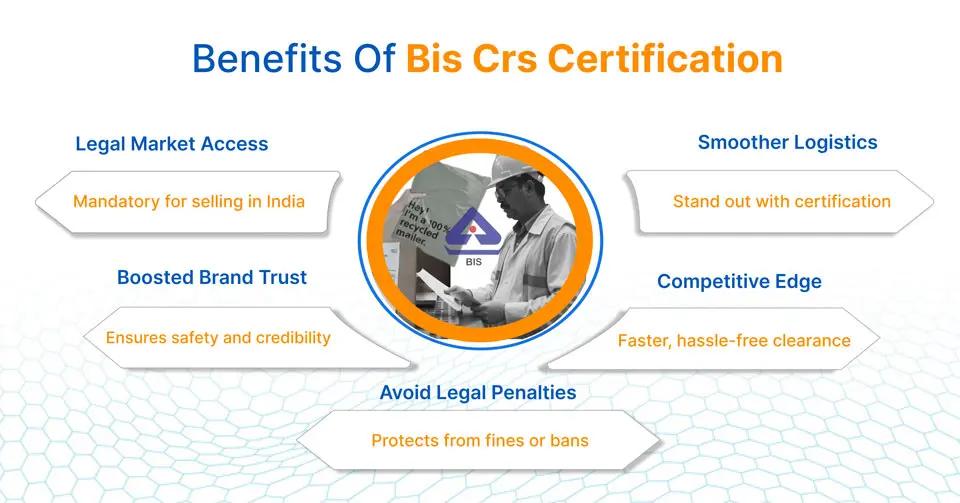
Source: Benefits of BIS Compliance
Ensuring Product Safety and Performance
BIS standards exist primarily to protect consumers from unsafe products. The testing requirements might seem excessive until you understand what they prevent. Certified batteries undergo rigorous testing that simulates years of use, abuse conditions, and failure scenarios that might occur in real life.
Thermal Safety: Battery fires make headlines because they can be devastating. BIS testing ensures your batteries will not overheat dangerously under normal or even abnormal conditions. Thermal runaway protection mechanisms must function properly to prevent one cell failure from cascading through the entire pack.
Electrical Safety: Overcharging, over-discharging, and short circuits are common electrical faults that can cause fires and explosions. BIS standards verify that protection circuits and BMS systems respond appropriately to these fault conditions, safely shutting down the battery before dangerous situations develop.
Mechanical Integrity: Batteries experience vibration during vehicle operation, shock from rough handling, and mechanical stress from mounting and environmental conditions. Testing ensures batteries withstand these forces without compromising safety or performance. A battery that breaks apart or has internal connections fail creates serious hazards.
Chemical Stability: The materials inside batteries must remain stable throughout the product's lifecycle. BIS testing verifies that materials do not degrade unexpectedly, that batteries do not swell excessively, and that they do not release hazardous substances during normal use or at end-of-life.
Performance Consistency: Certified batteries deliver consistent performance throughout their rated life. They meet capacity and power specifications not just when new but after hundreds of charge-discharge cycles. This consistency ensures consumers get the performance they paid for and expect.
For manufacturers, compliance means fewer product failures in the field, reduced warranty claims, and minimized liability risks. A single battery fire incident can destroy your brand reputation and expose you to legal liability. BIS certification helps prevent such disasters.
Building Trust and Market Acceptance
Beyond safety, BIS certification opens doors in the Indian market in ways that nothing else can.
Regulatory Compliance: Without BIS certification, you cannot legally sell covered battery products in India. Attempting to sell uncertified products exposes you to penalties, product seizures, and legal action. Certification ensures you can operate without regulatory interference.
Customer Confidence: The ISI mark is one of India's most recognized and trusted quality symbols. Consumers who might not understand technical specifications immediately recognize the ISI mark as indicating quality and safety. This recognition makes purchasing decisions easier for customers and reduces the sales effort needed to convince them of your product's quality.
B2B Opportunities: If you sell batteries to other manufacturers, OEMs almost universally require BIS certification from component suppliers. Certification is often a minimum qualification just to be considered for supplier evaluation. Without it, you cannot even start conversations with major customers.
Government Tenders: Public sector projects and government procurement programs mandate BIS-certified products. This requirement opens significant business opportunities in India's growing electric vehicle programs, renewable energy installations, and infrastructure projects. Government contracts can be substantial and lead to long-term business relationships.
Insurance and Financing: Financial institutions and insurance providers view BIS certification favorably when evaluating your business for loans or coverage. Certified products demonstrate lower risk profiles, potentially resulting in better lending terms, lower insurance premiums, and increased coverage availability.
Export Advantages: While not always mandatory for exports, BIS certification demonstrates commitment to international quality standards. Many international buyers recognize BIS as rigorous and credible, enhancing your competitiveness in global markets. Having BIS certification can differentiate you from competitors in countries where battery safety standards are less stringent.
Competitive Differentiation: The Indian battery market has many players, from established brands to new entrants to questionable operators. BIS certification differentiates serious manufacturers committed to quality from fly-by-night operators looking for quick profits. In a crowded market, certification becomes a clear signal of legitimacy and reliability.
Conclusion
BIS compliance for battery systems represents more than a regulatory requirement. It is a pathway to building a sustainable, trustworthy business in India's booming battery market. The certification process demands time, investment, and meticulous attention to detail, but the benefits far outweigh these challenges.
As India accelerates toward its ambitious electric mobility and renewable energy goals, the demand for quality battery systems will only intensify. The government has set targets for EV adoption and renewable energy capacity that require millions of new battery systems. Manufacturers who prioritize BIS compliance position themselves as reliable partners in this national transformation.
The certification process itself often reveals opportunities for improving manufacturing efficiency, product quality, and operational excellence. Many manufacturers find that the discipline required for BIS compliance makes them better companies overall. The quality systems, documentation practices, and testing capabilities developed for certification benefit every aspect of your business.
Start your compliance journey early, well before you need to launch products. Invest in quality systems as foundations, not afterthoughts. View BIS certification not as a bureaucratic hurdle but as a competitive advantage that distinguishes you in the marketplace. The Indian market rewards those who commit to safety, quality, and regulatory compliance with customer loyalty, business growth, and long-term success.
The path to BIS certification can be challenging, but thousands of manufacturers have successfully navigated it. With proper preparation, expert guidance when needed, and genuine commitment to quality, you can too. Your certified products will carry the ISI mark with pride, knowing they meet rigorous standards and contribute to India's sustainable energy future.
Frequently Asked Questions
1. What is the Typical Timeline for BIS Approval?
BIS certification typically takes 4-8 months from application to license grant, though foreign manufacturers should plan for 6-12 months due to additional coordination requirements.
2. Do All Lithium-Ion Batteries Need BIS Certification?
Yes, lithium-ion batteries for portable applications (phones, laptops, power banks) and electric vehicles require mandatory BIS certification under IS 16046 and IS 16893.
3. Is BIS Certification Accessible for Small-Scale Manufacturers?
Yes, BIS certification is available to manufacturers of all sizes, and small manufacturers can succeed by starting with limited product ranges and using consultant services for support.
4. Which Laboratories Are Authorized for BIS Testing?
BIS recognizes government labs like CPRI Bangalore, VRDE Ahmednagar, ICAT Manesar, and private labs like TUV India, Intertek, UL India, Bureau Veritas, and SGS India.
5. Do I Need BIS Compliance If I Am Only Exporting Products?
BIS compliance is not mandatory for products manufactured solely for export, but it remains valuable as it demonstrates quality to international buyers and provides flexibility to enter the Indian market.


