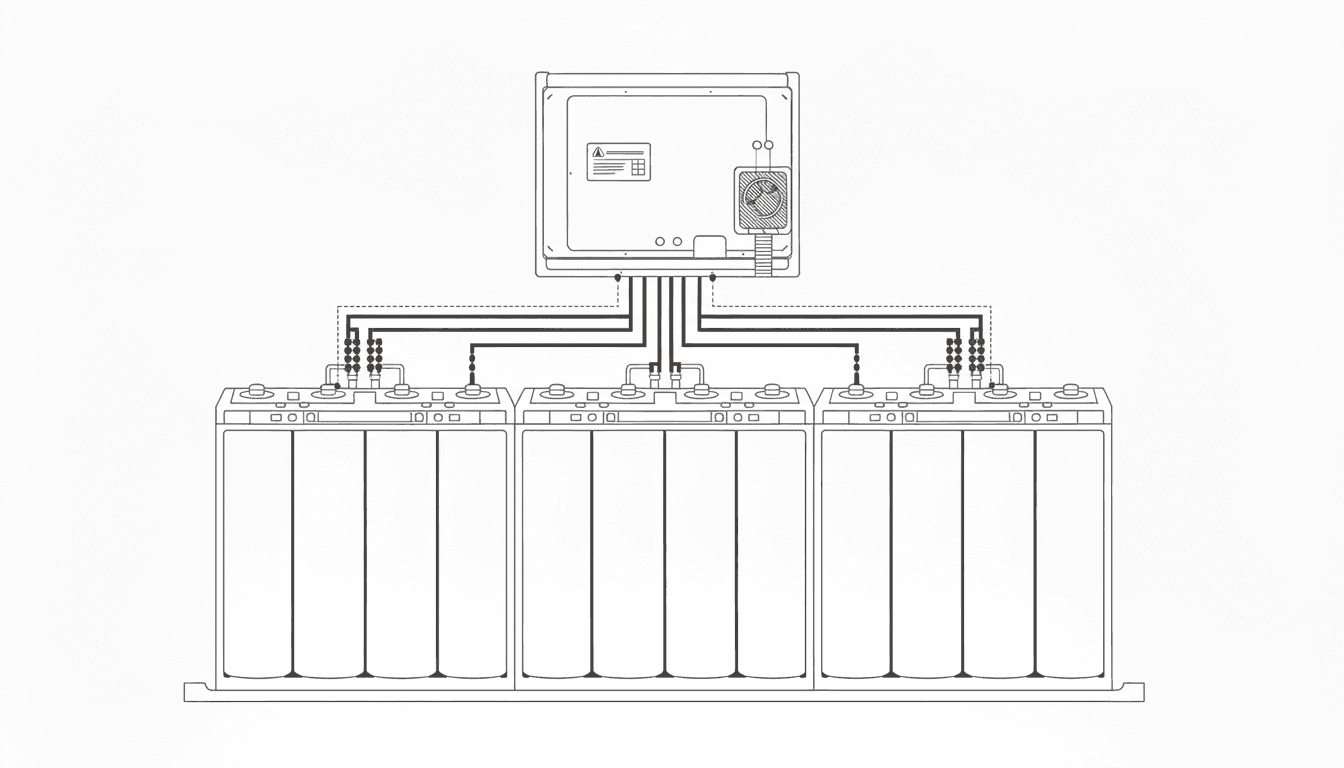
What is BMS
A Battery Management System (BMS) serves as the central control unit for rechargeable battery packs. It watches over everything, controls how the battery works, and keeps it safe. Whether it's in your electric car, solar power system, or laptop, the BMS constantly monitors voltage, temperature, and current to ensure optimal performance and prevent dangerous situations.
Why BMS Is Important
As batteries get bigger and more powerful, the role of the BMS becomes critical. In an electric car, a well-designed BMS does not just keep the driver safe it also extends driving range and increases battery life. In renewable energy systems, the BMS decides when to store power and when to release it, making solar and wind energy more practical.
Even the battery inside your phone depends on a BMS. It regulates charging levels, monitors thermal conditions, and maintains the safety and efficiency of every charge cycle. Without it, lithium-ion batteries would be risky for everyday use.
How BMS Architectures Have Evolved
The first BMS designs were fairly simple, mostly voltage checks and a basic shutdown feature if something went wrong. As batteries grew larger and applications more demanding, the systems had to become more sophisticated.
Modern BMSs operate similarly to networked control systems. They communicate with the rest of the vehicle or grid, adapt to how you use them, and in many cases, even learn over time. Architectures have shifted from single controllers to modular and distributed systems, often with wireless communication, cloud integration, and intelligent algorithms driving optimization.
The Basics of BMS Architecture
The Core Functions
Monitoring
The BMS continuously monitors cell voltages and the current flowing into and out of the battery pack. and temperatures at key locations. From this, it estimates state of charge (SOC), state of health (SOH), and remaining useful life. Detecting small irregularities such as one cell warming faster than the others allows it to act before problems escalate.
Balancing
No two cells are identical. Over time, small differences build up and can reduce both performance and safety. The BMS fixes this through balancing. Passive balancing releases excess charge as heat through resistors, while active balancing transfers charge from stronger cells to weaker ones. Choosing the method depends on application requirements, efficiency goals, and cost.
Protection
The BMS enforces safe operating limits. It prevents overcharge, deep discharge, overcurrent, and overheating. In extreme cases, it can disconnect the battery entirely via MOSFETs or contactors. Multiple protection layers ensure that even if one fails, others remain active to keep the system safe.
Key Components
To perform these functions, the BMS relies on:
Voltage sensors for accurate cell measurements.
Current sensors to track flow and calculate SOC.
Temperature sensors to identify hot spots.
Microcontrollers or BMS chips to process data and run control logic.
Balancing circuits (resistors or transfer networks).
Switching components like MOSFETs or relays for pack disconnect.
Together, these components form the foundation of any BMS architecture.
Standard BMS Topologies
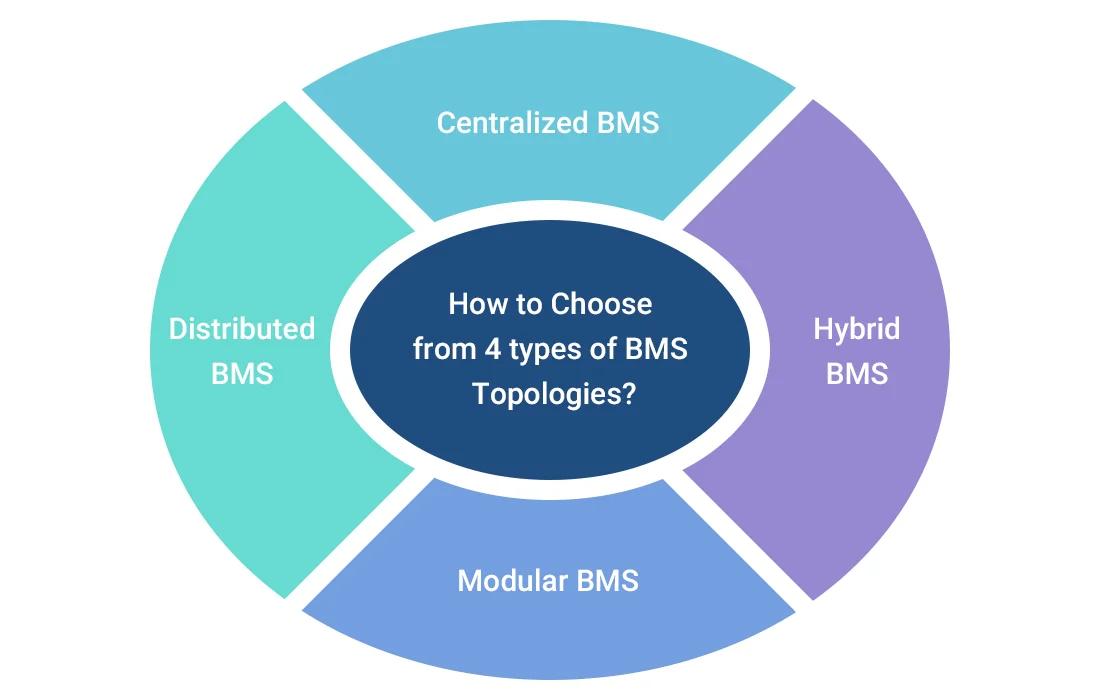
Source: Types of BMS topologies
Centralized BMS
How It Works All cell wires feed into one central unit. This single processor handles monitoring, balancing, and protection.
Advantages It is straightforward, relatively cheap, and works well for smaller packs. Having one control unit also simplifies software development and troubleshooting.
Limitations As packs get larger, the wiring becomes unmanageable, measurement noise increases, and one failure can disable the entire system.
Best Fit Centralized systems are common in small-scale applications like power tools, e-bikes, or consumer electronics with fewer than 20 cells.
Modular BMS
How It Works The battery pack is divided into sections, each with its own controller. These modules handle local monitoring and balancing, while a master controller oversees the full pack.
Advantages Wiring is simpler, the system scales easily, and maintenance is straightforward faulty modules can be replaced without tearing down the whole pack.
Communication Modules typically communicate over CAN bus or daisy-chained serial connections, passing their data to the master unit for coordination.
Best Fit This is the go-to architecture for EVs and medium-to-large stationary systems. It balances cost, reliability, and scalability.
Distributed BMS
How It Works Each cell (or small group of cells) has its own dedicated monitoring circuit, often integrated directly on the cell. Data is shared wirelessly or over high-speed serial lines.
Advantages This design delivers highly accurate measurements and maximum flexibility in pack layout. It works well in environments where space and wiring are challenging.
Challenges It is more expensive, requires more components, and depends on robust communication. Synchronization and power management across all the distributed units add complexity.
Current Use Distributed designs are still relatively rare outside of research labs and specialized applications like racing EVs, though improvements in wireless tech are making them more practical.
Advanced BMS Topologies
Hybrid Architectures
Rather than sticking with one approach, hybrids combine elements of centralized, modular, and distributed designs. For instance, modular units may monitor cells locally, while a central controller handles thermal management and pack-level decisions. This approach is popular in EVs because it blends scalability with centralized safety management. Automakers can reuse standard modules across models, while tailoring master control logic to each vehicle.
Intelligent and Adaptive Systems
With more processing power available, BMS designs are becoming “smarter.”
Machine learning helps improve SOC and SOH estimation by learning from historical data.
Adaptive balancing targets aging cells individually instead of applying the same algorithm across the whole pack.
Predictive maintenance identifies failing cells early, allowing preemptive servicing.
In EVs, this intelligence can even tailor charging and regenerative braking strategies to individual driving habits.
Scalable Systems for EVs and Grid Storage
Large systems require scalability above all else. Key features include:
Standardized modules that can be added as needed.
Hot-swappable units for easier maintenance.
Communication protocols that support mixed suppliers or phased deployment.
For automakers, scalable BMS designs allow platform-based strategies using the same module across multiple car types, from compact cars to SUVs. In grid storage, scalability lets operators expand capacity gradually without discarding earlier investments.
Key Things to Keep in Mind When Designing a BMS Communication Protocols
Since the BMS continuously shares data with both the cells and external devices, the communication method plays a crucial role:
In cars: systems usually use something called CAN or CAN FD. These are reliable, noise-resistant communication methods that have become the standard in the auto industry.
Inside modules: smaller, simpler connections like SPI or I²C are used to link chips and sensors within a board.
Connection layout: sometimes modules are connected in a chain (called daisy-chaining) which saves wiring, though it can add small delays.
What’s new: newer systems are starting to use wireless links or even Ethernet (the same technology your computer network uses), especially for big energy storage systems.
Thermal Management Heat is one of the biggest factors in how well batteries perform and how long they last. A BMS plays a key role in keeping temperatures under control:
Sensors are placed at key spots to quickly catch hot areas.
The BMS works with cooling systems—like fans, liquid coolant, or air conditioning in EVs.
During fast charging, the BMS balances speed and safety, since fast charging generates more heat.
In cold climates, it may even warm the battery so it can work properly.
If something goes wrong, the BMS can act early to stop thermal runaway (when heat builds up uncontrollably).
Safety and Compliance Because batteries can be dangerous if not properly managed, strict safety standards exist:
UL 2580: for electric vehicle batteries.
IEC 62619: for industrial energy storage systems.
ISO 26262: for overall functional safety in automotive electronics.
These rules shape how BMS systems are built. They require backups for critical features, detailed testing, and careful documentation so every safety measure can be traced and verified. On top of official standards, engineers also follow best practices like using multiple protection layers and thoroughly checking software.
The Future of BMS Architecture AI and IoT Integration
Connected BMS units are already leveraging cloud computing and big data. By aggregating data across fleets, manufacturers can refine algorithms, predict failures earlier, and improve products faster. Fleet learning is especially powerful: when one vehicle discovers a better charging strategy, the update can be shared across thousands of vehicles. Security and privacy will be ongoing challenges, requiring encryption, secure updates, and clear policies on what data is shared.
Cloud-Based Monitoring
Remote monitoring allows operators to oversee thousands of packs at once, whether in fleets or grid storage. For manufacturers, this visibility helps catch warranty issues early. For fleet managers, it enables smarter charging schedules and routing.
Edge computing ensures safety-critical decisions remain local, while less urgent analytics can be handled in the cloud.
Solid-State Battery Management
Solid-state batteries will bring both simplifications and new challenges. While they remove some risks (like leakage and certain thermal events), they introduce others (mechanical stresses, new failure modes).
Future BMS designs will need flexible, software-driven architectures that can adapt to both lithium-ion and solid-state chemistries. Advanced sensing methods like fiber optics, acoustic monitoring, or gas detection may play a role in ensuring safety.
Conclusion
The journey of BMS design reflects the growth of battery technology itself. From basic centralized systems to intelligent, cloud-connected architectures, the BMS has become as essential as the battery it manages.
Designers today must balance performance, cost, safety, and scalability choosing the right topology for the application while planning for rapid innovation ahead. With AI, IoT, and new chemistries like solid-state on the horizon, the BMS will only become more central to modern energy systems.
Frequently Asked Questions:
1. What is the lifespan of a BMS?
In cars, about 10-15 years. In stationary systems, 15–20 years is typical, often outlasting the battery itself.
2. How does a BMS affect charging speed?
It adjusts charge rates in real time to balance speed with safety, preventing overheating or overvoltage conditions.
3. Can a BMS be reused in another pack?
Only if the chemistry, voltage, and configuration match but it’s rarely recommended due to safety risks.
4. Do all EVs use the same BMS?
No. Each automaker designs around its needs, though most follow similar standards for safety and communication.
5. What happens if a BMS fails?
Most are designed to fail safe by disconnecting the battery. Partial failures may limit performance or trigger warnings until the system is serviced.


