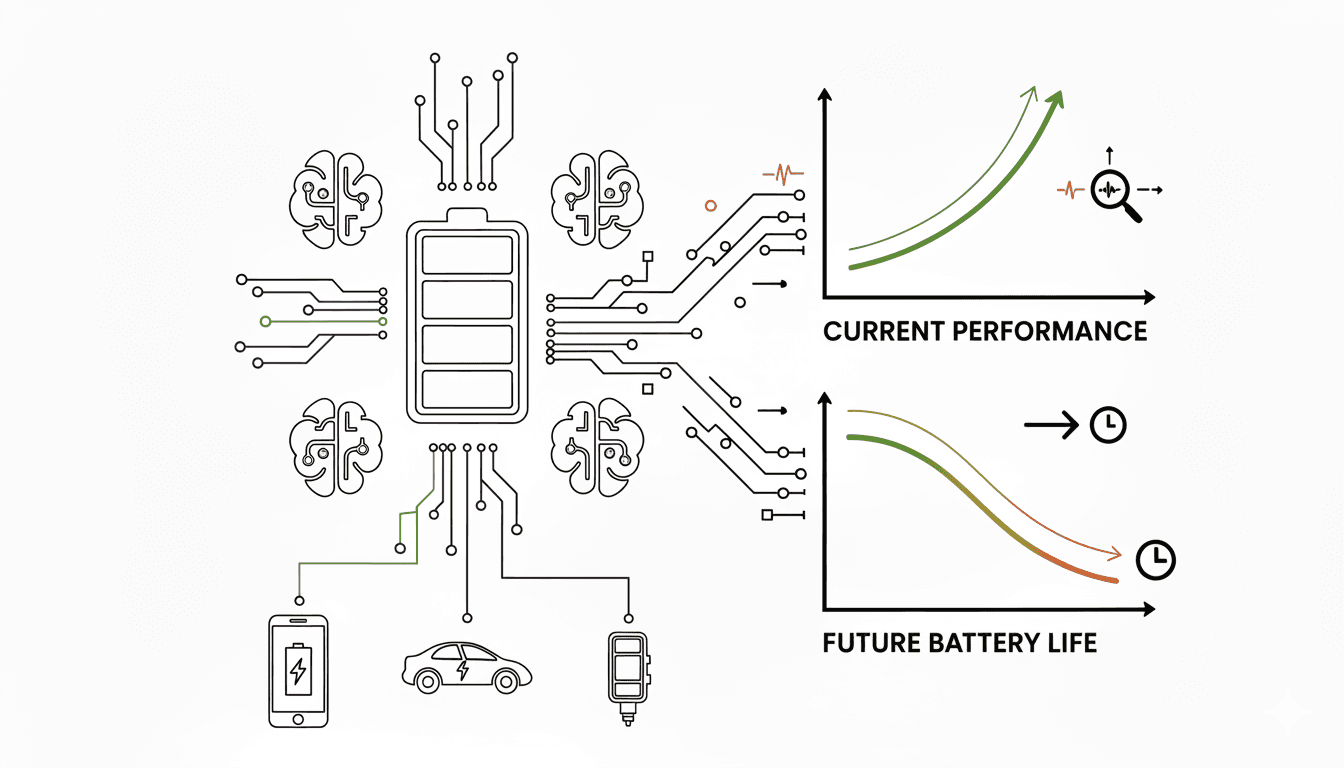
Battery life prediction is like having a smart assistant that knows exactly when your batteries need attention. Just as weather forecasts help you plan your day, AI-powered battery prediction tells you exactly when your batteries will need attention, helping you avoid unexpected failures and maximize their useful life.
Importance of battery life prediction
Knowing when batteries will fail or degrade is crucial for modern life. Whether it's your smartphone dying during an important call, an electric car running out of power on the highway, or a hospital's backup system failing during a power outage, battery failures can be inconvenient, expensive, or even dangerous.
Traditional battery management has been like driving a car without a fuel gauge the warning signs appear only once damage is done. This reactive approach leads to unexpected breakdowns, costly emergency replacements, and missed opportunities to optimize performance.
Role of AI in transforming the field
Artificial Intelligence is changing battery management from guesswork into precise science. AI systems can analyze thousands of data points every second, learning from patterns that humans could never detect. This transformation means batteries that last longer, systems that run more reliably, and significant cost savings across industries.
AI does not just monitor batteries, but it also understands them. By processing historical data, real-time measurements, and environmental conditions, AI creates intelligent predictions that help optimize battery performance throughout their entire lifecycle.
Understanding Battery Life Prediction
What it means
Battery life prediction is the science of forecasting how long batteries will continue to perform effectively. Think of it like predicting how many miles you can drive before needing to refuel, but much more complex because instead of suddenly going empty, batteries gradually decline in their ability to store energy.
This prediction involves understanding three key aspects, how much energy a battery can store now (current capacity), how quickly this capacity is declining (degradation rate), and how external factors like temperature, usage patterns, and charging habits affect this process.
Challenges with traditional methods
Traditional battery monitoring has been like trying to predict the weather by just looking out the window. Conventional systems rely on simple measurements like voltage and current, providing only a snapshot of the current moment without understanding long-term trends or complex interactions.
Old methods struggle with accuracy because they can't account for the many factors that affect battery life. Temperature changes, charging speeds, usage patterns, and even the age of the battery all influence performance in ways that simple monitoring can't capture.
Manual testing and periodic check-ups miss the gradual changes happening daily. By the time traditional methods detect problems, significant degradation has already occurred, making it too late for preventive action.
How AI Enhances Battery Prediction
Machine learning models
AI uses machine learning like a super-smart student that never stops learning from experience. These models analyze millions of battery cycles, learning patterns from successful batteries and failed ones alike.
Neural networks process complex relationships between different factors, how temperature affects charging efficiency, how different usage patterns impact lifespan, and how various battery chemistries behave under stress. These models become more accurate over time, continuously improving their predictions as they process more data.
Advanced algorithms can identify subtle warning signs that humans would miss entirely. They spot tiny changes in charging curves, detect unusual temperature patterns, and recognize early indicators of chemical degradation inside the battery cells.
Data-driven insights
AI transforms raw sensor data into actionable intelligence. While traditional systems might collect temperature and voltage readings, AI understands what these measurements mean in context, combining them with historical trends, environmental data, and usage patterns.
Real-time analysis means AI can instantly recognize when something changes. If a battery starts charging differently or shows unusual temperature patterns, AI flags these changes immediately rather than waiting for problems to become obvious.
Predictive models use this data to forecast not just when batteries will fail, but how their performance will change over time. This allows for planned maintenance, optimal replacement scheduling, and strategic system upgrades.
Real-world Case Studies
EV battery prediction
Tesla and other electric vehicle manufacturers use AI to monitor millions of battery cells across their fleet. Their systems analyze driving patterns, charging habits, and environmental conditions to predict battery health and optimize charging strategies.
In one implementation, AI helped extend battery life by 25% by adjusting charging speeds based on temperature, usage patterns, and the battery's current health status. The system learned that slower charging in hot weather and avoiding full charges unless necessary significantly improved longevity.
BMW's AI system predicts individual battery cell failures weeks before they occur, allowing technicians to replace specific cells rather than entire battery packs. This approach has reduced warranty claims by 40% and saved millions in replacement costs.
Fleet operators using AI-powered battery prediction report 60% fewer unexpected vehicle breakdowns and 30% longer battery life compared to traditional management methods. These improvements translate directly into lower operating costs and better customer satisfaction.
Renewable energy storage systems
Large-scale solar and wind farms use AI to manage massive battery storage systems that smooth out power generation from intermittent renewable sources. These systems must predict not just battery health, but optimal charging and discharging strategies to maximize both energy storage and battery lifespan.
A solar farm in Rajasthan uses AI to manage thousands of battery modules, predicting performance under extreme heat and desert conditions. The system optimizes charging during cooler night hours, increasing storage efficiency by 15% and extending battery life by nearly 3 years.
Grid-scale storage operators report that AI prediction has reduced maintenance costs by 50% and improved system reliability by 35%. These improvements are crucial for making renewable energy more practical and cost-effective.
Smart grid applications use AI to predict when and how to use stored energy most effectively, balancing immediate power needs with long-term battery health. This optimization helps reduce peak electricity costs and improves overall grid stability.
Consumer electronics applications
Smartphone manufacturers like Apple and Samsung use AI to optimize battery charging patterns based on user behavior. These systems learn when you typically charge your phone and adjust charging speeds to minimize battery degradation while ensuring your device is ready when you need it.
Laptop computers now use AI to predict battery health and adjust power management accordingly. These systems can extend battery life by up to 20% by optimizing processor performance, screen brightness, and background activities based on predicted usage patterns.
Wearable devices like smartwatches use AI to balance battery life with functionality, learning your daily routines and adjusting sensor sampling rates, display settings, and connectivity features to maximize battery performance throughout your typical day.
Gaming devices and tablets employ AI to predict thermal conditions and adjust performance dynamically, preventing battery damage from overheating while maintaining optimal user experience during demanding applications.
Benefits of AI-Powered Prediction
Improved accuracy
AI prediction systems achieve 90-95% accuracy in battery life forecasting, compared to 60-70% accuracy with traditional methods. This improvement means better planning, fewer surprises, and more confident decision-making about battery replacement and maintenance schedules.
Machine learning models continuously improve their accuracy by learning from new data and refining their understanding of battery behavior patterns. This means systems become more precise over time, providing increasingly reliable predictions.
AI can predict specific failure modes, not just general battery health decline. This detailed forecasting helps technicians prepare for specific types of maintenance and ensures the right replacement parts are available when needed.
Cost savings and efficiency
Organizations using AI-powered battery prediction report average cost savings of 30-40% on battery related expenses. These savings come from reduced emergency repairs, optimized replacement timing, and extended battery lifespans through better management.
Planned maintenance costs significantly less than emergency repairs. AI enables proactive scheduling during planned downtime, reducing labor costs and minimizing disruption to operations. Companies report maintenance cost reductions of 50-60% compared to reactive approaches.
Energy efficiency improvements of 15-25% are common with AI-optimized battery systems. Smart charging algorithms, optimized discharge patterns, and better thermal management all contribute to more efficient energy use and reduced electricity costs.
Extending battery lifespan
AI-managed batteries typically last 20-40% longer than those managed with traditional methods. This extension comes from optimal charging practices, better thermal management, and avoiding operating conditions that accelerate degradation.
Preventive care guided by AI predictions helps batteries maintain higher capacity for longer periods. By identifying and addressing minor issues early, AI prevents small problems from cascading into major degradation events.
Strategic usage optimization means batteries operate within their ideal parameters more often. AI learns the best operating conditions for different situations and automatically adjusts system behavior to maximize longevity without compromising performance.
Future Outlook
Integration with IoT and smart grids
The Internet of Things (IoT) will connect every battery to intelligent networks, creating vast ecosystems of shared knowledge and coordinated optimization. Batteries in electric cars, homes, and businesses will communicate and coordinate to optimize energy use across entire communities.
Smart grids will use AI-predicted battery availability to balance energy supply and demand in real-time. This coordination will make renewable energy more practical by ensuring stored energy is available exactly when and where it's needed most.
Vehicle-to-grid systems will use AI predictions to optimize when electric cars charge and discharge, turning parked vehicles into a widely connected battery system that supports grid stability while maximizing battery life.
Emerging opportunities
Edge computing will bring AI processing directly to battery systems, enabling instant responses without relying on internet connections. This advancement will make AI battery management practical for remote installations and mission-critical applications.
Quantum computing may eventually revolutionize battery chemistry modeling, allowing AI to understand battery behavior at the molecular level and predict performance with unprecedented accuracy.
Integration with renewable energy forecasting will create systems that predict both energy generation and storage needs simultaneously, optimizing the entire renewable energy ecosystem for maximum efficiency and reliability.
Advanced materials research guided by AI will lead to new battery chemistries specifically designed to work optimally with intelligent management systems, creating batteries that are both inherently durable and more responsive to AI optimization.
Conclusion
AI is transforming battery life prediction from reactive maintenance to proactive optimization. This innovation has moved beyond simple monitoring to create intelligent systems that understand, predict, and optimize battery performance in ways previously impossible.
Real-world implementations across industries demonstrate significant benefits: improved accuracy, substantial cost savings, and notably extended battery lifespans. From electric vehicles to renewable energy storage, AI-powered prediction is proving its value through measurable results.
The future holds even greater promise as AI systems become more sophisticated and interconnected. Integration with IoT, smart grids, and emerging technologies will create battery management ecosystems that optimize performance across entire communities and industries.
Organizations investing in AI-powered battery prediction today are positioning themselves for a future where energy storage is more reliable, cost-effective, and environmentally sustainable. The technology has matured from experimental to essential, making now the ideal time to embrace AI-driven battery management.
As our world becomes increasingly dependent on battery-powered devices and systems, AI prediction technology will play a crucial role in ensuring reliable, efficient, and long-lasting energy storage solutions for everyone.
Frequently Asked Questions
1. How does AI handle battery degradation patterns?
AI analyzes charge cycles, temperature, and usage data to spot early degradation signs. It learns different failure patterns and predicts performance changes, helping extend battery life through optimized usage strategies.
2. Is AI useful for small-scale battery systems?
Yes, AI works for all sizes from smartphones to home batteries. Cloud-based services make it affordable for small systems, optimizing charging and predicting replacements without expensive hardware.
3. Can AI predict sudden battery failures?
AI better predicts gradual wear than sudden failures, but it spots warning signs like overheating or defects. Monitoring multiple factors helps detect risky patterns for preventive action.
4. What role does data quality play in AI models?
Poor data creates poor predictions. Quality sensors and proper calibration are essential for accurate AI models. Bad data leads to false alarms and missed problems.
5. How secure is AI-powered battery monitoring?
Systems use encryption and secure protocols to protect data. Edge computing keeps information local. Multiple security layers prevent cyber threats through isolation and regular audits.


