Have you ever been curious about why your mobile phone displays a full charge indicator yet runs out of power rapidly? Or perhaps you have noticed that your older laptop fails to maintain its charge for extended periods, despite being completely charged? The solution to these questions involves learning about two crucial concepts: SOC and SOH. These measurements function similarly to a medical checkup for your battery. In the same way that you require both nutrition (fuel) and wellness to engage in physical activities, batteries depend on both electrical charge and optimal condition to operate effectively.
What is SOC (State of Charge)?
SOC stands for State of Charge. Think of it like the fuel gauge in a car. It tells you how much energy is left in your battery right now. When your phone shows 80% battery, that is the SOC. It is measuring how full or empty your battery is at this moment.
SOC is measured using special sensors that check the voltage and current flowing in and out of the battery. Modern devices use smart battery management systems that calculate SOC by tracking how much electricity goes in when charging and how much comes out when you use the device. It is like monitoring the level of liquid in a container by recording how much you add and how much you remove.
SOC plays a direct role in battery performance because it tells you how long you can use your device before needing to charge again. If your SOC is 50%, you have half the power available. This helps you plan your day and know when to plug in your device.
What is SOH (State of Health)?
SOH stands for State of Health. This is different from SOC. While SOC tells you how much charge is left, SOH tells you how healthy the battery is overall. Think of a brand new fuel tank in a vehicle that can store 50 liters of fuel. After many years of use, corrosion and damage might reduce its capacity so it can only hold 40 liters. That is what SOH measures for batteries.
Several factors affect SOH. Temperature is a big one. Batteries do not like extreme heat or cold. Using your phone in very hot weather or leaving it in a cold car damages the battery slowly. The number of charge cycles also matters. Every time you charge and discharge your battery, it wears out a little. Fast charging, while convenient, can also reduce battery health over time. Even the age of the battery matters. Just like milk has an expiry date, batteries naturally degrade as they get older.
SOH is crucial throughout the battery lifecycle. A battery with 100% SOH is brand new and works perfectly. As SOH drops to 80% or 70%, the battery cannot hold as much charge anymore. This is why your old phone dies faster than when it was new, even when both show 100% charge.
Key Differences Between SOC and SOH
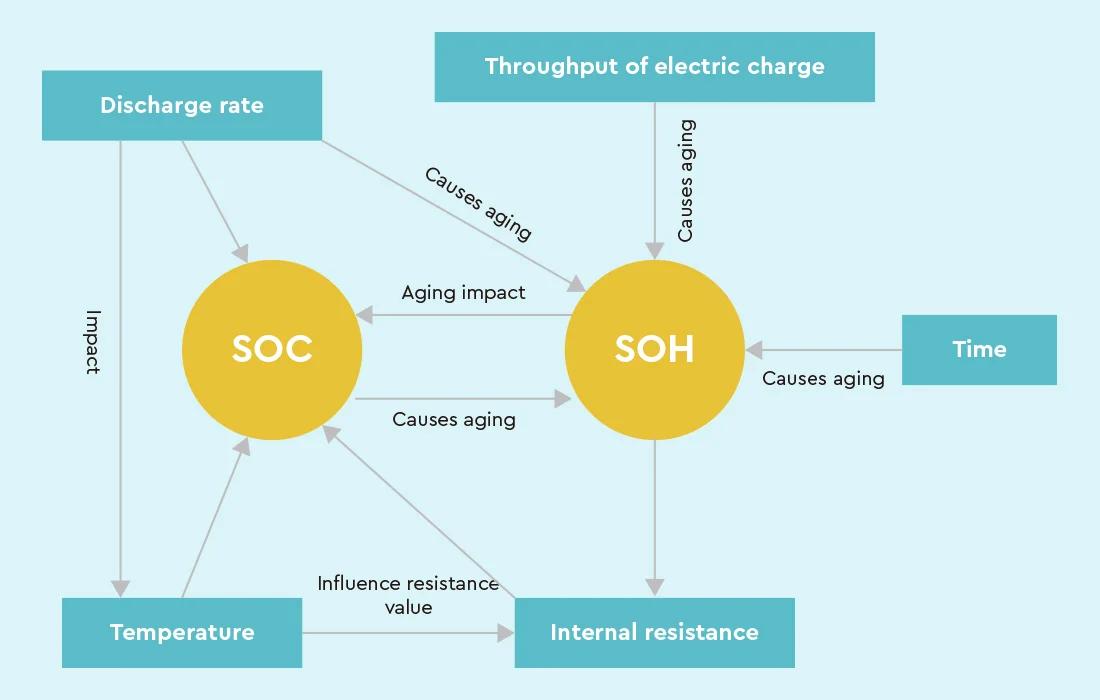
Source: Differences between battery state
Measurement Focus: SOC measures current energy level (how full the battery is right now), while SOH measures overall battery condition (how healthy the battery is compared to when it was new).
Time Sensitivity: SOC changes constantly throughout the day as you use and charge your device. SOH changes very slowly over months and years as the battery ages.
Primary Indicator: SOC is an indicator of available energy. It tells you the amount of power available for immediate use. SOH is an indicator of capacity loss. It reveals the extent of battery deterioration since its original state.
Calculation Basis: SOC is determined by comparing the present charge amount with the total storage capacity. For instance, a battery with 3000 mAh capacity that presently contains 1500 mAh would show an SOC of 50%. SOH is determined by evaluating how the current full capacity compares to the initial capacity when new. For example, a battery designed to store 3000 mAh that now reaches only 2400 mAh when fully charged would have an SOH of 80%.
User Perspective: SOC is what you see on your screen every day as the battery percentage. SOH is usually hidden but can be checked in battery settings or with special apps.
Impact on Usage: Low SOC means you need to charge soon. Low SOH means your battery will not last as long between charges, even at 100% SOC.
Applications: SOC helps with daily planning and energy management. SOH helps decide when to replace a battery or plan for reduced performance.
Accuracy Challenges: SOC can be measured fairly accurately in real time, though it sometimes jumps or drops unexpectedly. SOH is harder to measure precisely because it requires comparing performance over long periods and involves complex calculations.
Real World Example: Imagine two identical phones. Phone A is brand new with 100% SOH and 50% SOC. It will last several hours before dying. Phone B is two years old with 70% SOH but shows 50% SOC. Even though both show 50% battery, Phone B will die much sooner because its total capacity has decreased. Phone A might give you 5 hours of use, while Phone B might only give you 3.5 hours, even though both started at the same SOC.
Why Both SOC and SOH Are Critical
For Electric Vehicles: In electric vehicles, SOC tells drivers how far they can travel before charging, just like a fuel gauge. This is essential for trip planning and avoiding getting stranded. SOH is equally important because it determines the actual range of the vehicle. An electric car with 80% SOH will not travel as far on a full charge as when it was new. Car manufacturers monitor both to ensure safety, optimize charging strategies, and inform owners when battery replacement might be needed.
For Renewable Energy Storage: Solar and wind energy systems store excess power in large battery banks. SOC helps manage daily energy flow. During the day, solar panels charge the batteries (increasing SOC), and at night, the stored energy is used (decreasing SOC). SOH is critical for long term planning. Energy storage systems are expensive investments, and knowing the SOH helps predict when batteries need replacement and whether the system is performing as expected. Poor SOH means the system cannot store as much renewable energy, reducing its effectiveness.
For Consumer Electronics: Your smartphone, laptop, and wireless earbuds all depend on battery health monitoring. SOC helps you get through the day by showing when you need to charge. You check it constantly to plan your activities. SOH is important for device longevity. When SOH drops too low, your device becomes frustrating to use because it dies too quickly. Many modern devices will show a warning when SOH drops below 80%, suggesting a battery replacement. This helps users make informed decisions about repairs versus buying new devices.
Challenges in Monitoring SOC and SOH
Monitoring SOC and SOH accurately is harder than it seems. For SOC, the main challenge is that batteries do not discharge evenly. Your phone might drop from 100% to 90% slowly, then from 20% to 10% very quickly. Temperature also affects SOC readings. A cold battery might show lower SOC than it actually has. Additionally, different activities drain batteries at different rates. Playing a game drains much faster than reading text, making it hard to predict exactly how long your charge will last.
SOH monitoring faces even bigger challenges. There is no simple sensor that directly measures battery health. Instead, systems must track usage patterns over weeks and months, measuring how the battery performs under different conditions. Factors like temperature history, charging habits, and usage patterns all need to be considered. Many devices use algorithms and machine learning to estimate SOH, but these estimates are not always perfectly accurate. Different measurement methods can give different SOH values for the same battery. Some batteries also degrade unevenly, where certain cells inside the battery pack age faster than others, making overall SOH calculation complex.
Another challenge is that both SOC and SOH can be affected by calibration issues. Sometimes your battery percentage might jump around because the system needs to recalibrate its measurements. This is why occasionally letting your battery fully discharge and then fully charge can help improve accuracy.
Future of Battery Health Monitoring
The future of battery health monitoring is exciting and rapidly evolving. Artificial intelligence and machine learning are making SOC and SOH predictions much more accurate. Smart algorithms learn your usage patterns and can predict battery behavior better than ever before. These systems can even suggest optimal charging times and patterns to extend battery life.
New sensor technologies are being developed that can monitor individual cells within a battery pack, providing much more detailed health information. This is especially important for large battery systems in electric vehicles and energy storage. Some researchers are working on batteries with built in sensors that can detect early signs of damage or degradation before they become serious problems.
Cloud connected battery management systems are becoming common, where data from millions of devices helps improve SOC and SOH algorithms for everyone. Your device can benefit from patterns learned from other similar devices worldwide. Wireless charging technology is also being improved to monitor battery health during charging and adjust power delivery to maximize battery lifespan.
We are also seeing the development of batteries that can communicate their health status more directly. Future batteries might be able to tell devices exactly how healthy they are without complex calculations. Solid state batteries, which are being developed as the next generation of battery technology, promise longer life and easier health monitoring.
Battery management systems are also becoming smarter about protecting battery health. They can automatically adjust charging speeds, limit maximum charge levels, and manage discharge rates to extend SOH. Some systems even consider weather forecasts and your schedule to optimize when and how to charge.
Conclusion
Understanding the difference between SOC and SOH is essential for anyone who uses battery powered devices, which is almost everyone today. SOC tells you about your battery's current charge level, answering the immediate question of how much power you have left. SOH tells you about your battery's overall health, explaining why your device might not last as long as it used to.
Both measurements work together to give you a complete picture of your battery's condition. A high SOC with low SOH means you have a full charge but will not get much use from it. A low SOC with high SOH means you need to charge soon, but your battery is still healthy and will perform well once charged.
As we move toward a more electrified world with electric vehicles, renewable energy systems, and increasingly portable electronics, understanding battery health becomes even more important. Good battery health monitoring helps you make better decisions about when to charge, how to charge, and when to replace batteries. It saves money, reduces waste, and ensures your devices perform reliably when you need them most.
The technology for monitoring SOC and SOH continues to improve, making our devices smarter and more efficient. By understanding these concepts, you can take better care of your batteries and get the most out of your devices for years to come.
Frequently Asked Questions
1. Does SOH affect charging speed?
Not directly, but batteries with low SOH may charge slower as the system protects the degraded battery from further damage.
2. What tools measure SOC accurately?
Battery management systems in devices measure SOC using voltage sensors and current tracking algorithms built into the hardware.
3. Is SOH the same as battery life?
No, SOH measures current health compared to new condition, while battery life refers to how long the battery lasts on a single charge.
4. Is SOC more important than SOH?
Both are important for different reasons; SOC helps daily usage planning while SOH indicates long-term battery condition and replacement needs.
5. What causes a rapid drop in SOH?
Extreme temperatures, frequent fast charging, deep discharge cycles, physical damage, and manufacturing defects can cause rapid SOH decline.


